Top Stories
Stories in Psyche that you’ll love, handpicked by our team.
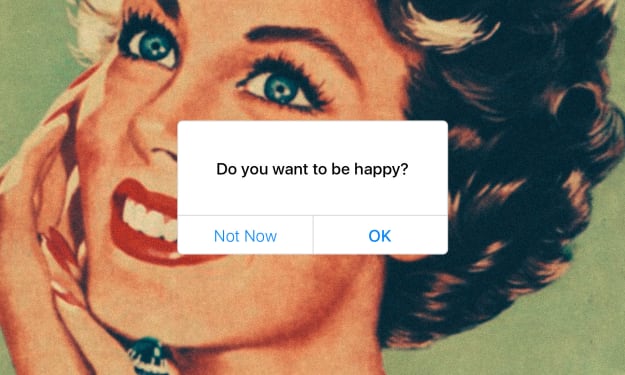
I Just Want to Be Happy. Or Do I?
As a society, we have accepted the belief that emotions disrupt rational thought, and any state other than happiness is a mental inconvenience or imbalance. This causes us to chase after pleasure, instant gratification and external validation instead of examining our inner world and what it is that we truly want. When something upsets us, we distract ourselves. We rarely face the issue and figure out a way to fix it.
By Sarah McDaniel8 years ago in Psyche
Depression
Why do I not want to get up? Why do I feel like a failure? Is this how society sees me, or is this how I see myself? Can I no longer enjoy the things that I used to? There is an epidemic, not just in America, but in the world. Depression affects millions of people. Some people do not even realize they have it, or choose to ignore it. Some of the questions above are symptoms of depression. There is also loneliness, fatigue, loss of appetite, among other symptoms.
By James Howell8 years ago in Psyche
I Am Not a Patient
2013 was the year everything changed. It was dark time in my life a few years ago when everything familiar to me was changing—a period I can only describe as a complete breakdown of my mentality. So much had happened all at once. My heart was broken for the first time, I had just finished my GCSEs and left school with the obscure challenge of college looming. My Nan was ill and my mental health was rapidly declining—all of this at that frustrating age where you’re expected to act like an adult whilst still being treated like a child.
By Meg Burchell8 years ago in Psyche
Cyber Bullying is Killing People…
When I was younger, I was bullied. Sometimes I think that it wasn’t that bad, largely because no adult seemed to care that much. But since the memory of being punched in the face till I was knocked on the floor, by a boy in my class, and the memory of having leaves stuffed into my mouth in the bushes of my school playground by girls older than me, stand out above most of my other memories from school… I’m going to assume it was kind of bad. It maybe fucked with my head a bit.
By Samantha Bentley8 years ago in Psyche
How My Claircognizance Makes Me Crazy
Claircognizance is defined as “clear knowing,” which I have in abundance. It is a sixth sense, which is helping my five physical senses of sight, touch, smell, hearing, and taste. I have normal senses and I have metaphysical senses. When something randomly pops into my head, like a Scrabble word when I’m playing, this is using my claircognizance. When I suddenly know something about what mental health diagnosis a person has, this is also my claircognizance. There are many ways I access this faculty. Claircognizance is something that can get me the right answer in class as well, often when it filters through from trance channeling the reading material.
By Iria Vasquez-Paez8 years ago in Psyche
When Abuse Pretends It Isn't
Ok, so this is going to be a touchy article, regardless of what experience you have with it. Talking about mental illness (especially when you don't suffer from anything too serious yourself) is usually considered a little off-base. I try to keep my opinions to myself regarding most precarious social issues because no matter what it seems to cause unnecessary upset feelings and judgement, even if nobody is willing to admit it. But hey, I feel like this is important, and I wish I could have read something like this a year ago when I was in the throes of an abusive relationship and battling a mental illness that wasn't my own. If you've ever felt trapped by guilt, you probably have a good idea where I'm coming from. It really makes you question your morality. I never saw myself as someone who would abandon a person battling a MI, I thought it would make me a bad person and some days I feel like it does.
By Carly Anne 8 years ago in Psyche
How Our Subconscious Controls Us
Theories of the unconscious mind varied widely between physiological groups, from the unconscious being a vault of traumatic memories, socially acceptable desires and painful emotions to the idea that the unconscious mind is merely a collection of the cognitive process that has no affect on our behavior and aren't aware of. Luckily, we now know through extensive research and a significant amount of proof that the unconscious mind is no less controlling, flexible, complex, action- oriented or deliberative that its coequal.
By Sarah McDaniel8 years ago in Psyche