
The Power Behind Bitcoin
A city’s load in one site

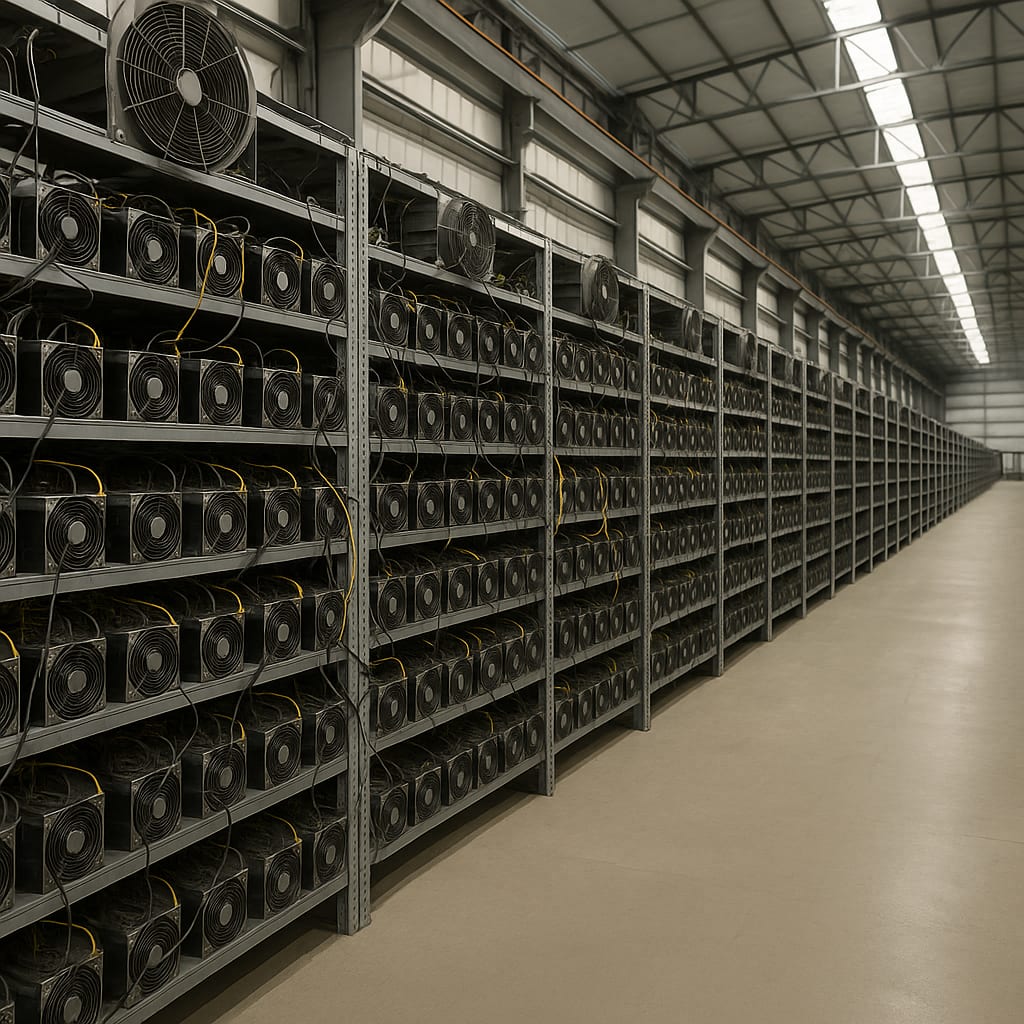
Bitcoin borrowed a word that does not belong to it. Mining sounds physical. It carries an image of dirt, steel, and effort. It suggests men who work in tunnels and move rock by the ton. When the public hears it, they picture a job that leaves a body tired in a way that makes sense. None of that exists in a modern Bitcoin facility. What you find instead is a heat-filled building lined with machines made for only one purpose. Each machine is a miner. One miner equals one computer. Thousands of them sit in rows, running without rest. Once a person understands that a miner is not a human but a device that never sleeps, the scale becomes easier to grasp. These machines fire through guesses at high speed. Each one is trying to match the one valid answer the network will accept. The winning machine earns the reward. All other miners (computers) try again. The entire operation is a probability race powered by electricity.
I was talking to an electrician I know who is working on the new Childress, Texas bitcoin campus. The full buildout is listed at 750 megawatts of capacity. This number places the site in the company of major industrial facilities. Capacity matters, but the live load matters more. Reports place the active draw near 350 megawatts. That is the grounded number, the one tied to present-time electrical behavior.
My sister-in-law works at an electric company. A 350 megawatt load equals roughly 350,000 kilowatts moving through the system every hour. When that number is compared with the average moment-to-moment use of a U.S. home, you arrive at a real-world anchor.
The site is drawing the same electricity that about 280,000 homes would be using at the same time. In practical terms, a single industrial customer is drinking the power of a mid-sized city. This is not a speculative comparison. It is a direct expression of what is flowing through the grid at any given second.
The next question is whether anyone can afford to feed an operation of that size. Electricity is not a background cost. It is the raw material of the business. A 350 megawatt continuous draw produces a monthly bill in the range of $150 million - $250 million, depending on the contract rate. Only a short list of operators can carry that load.
- Large publicly traded mining companies pay it with investor capital, structured debt, stock dilution, and grid incentives.
- Private equity groups cover it through financial models built to tolerate sustained burn.
- Hybrid data centers pay it by hosting artificial intelligence hardware and selling compute cycles.
These operations are not small businesses. They are capital engines designed to survive through scale and to shift risk onto the financial structures that support them.
Texas created conditions that make this possible. ERCOT allows large customers to enter demand response programs. This gives a mining operator the ability to shut down quickly when the grid is strained and to receive payments as though the machines had stayed online. In some cases, the operator can sell unused power back into the market. The arrangement helps miners earn income in more than one way. They mine when the economics align and they monetize flexibility when prices swing.
A household does not receive this option. When the grid is stressed, residential customers receive alerts, higher prices, or outages. The benefits concentrate in the hands of operators who hold large controllable loads.
Bitcoin introduces its own form of instability. It is not tied to production, cash flow, or physical value. The price can move sharply in short time frames. A company that appears solvent in the spring can be underwater by fall if the spot price or the difficulty curve shifts against it.
- Hardware ages fast.
- New machines outpace old ones.
- Electricity prices fluctuate.
- Policy changes land without much warning.
An operation drawing 350 megawatts must outrun all these variables long enough to cover the cost of land, transformers, machines, cooling, and labor. Some will. Others will not. When a site fails, the grid and the community inherit the footprint.
The question that matters most is not whether Bitcoin grows or contracts. The question is who absorbs the long-term risk.
- The investor sees opportunity.
- The operator sees a business model.
- The grid sees a heavy, predictable load.
- The community sees whatever remains once the market mood changes.
They do not receive dividends for the strain they carry. They experience only the physical consequences of a private enterprise built on public infrastructure. That is the part of the story that rarely reaches the surface.
When someone hears the phrase Bitcoin mining, they should not picture a man with a pick. They should picture a building wired to pull a city’s worth of electricity into machines that race through guesses for a reward that shifts by the hour.
Sources That Don’t Suck
Cambridge Centre for Alternative Finance. Global cryptoasset benchmarking study. Cambridge University Press.
Digiconomist. Bitcoin energy consumption index. Stichting Digiconomist.
IREN. Corporate filings and site capacity reports for Childress campus. IREN Limited.
U.S. Energy Information Administration. Electric power monthly. U.S. Department of Energy.
Wong, J. (2024). Bitcoin mining expansion and grid interactions in Texas. MIT Press.
About the Creator
Dr. Mozelle Martin
Behavioral analyst and investigative writer examining how people, institutions, and narratives behave under pressure—and what remains when systems fail.
Keep reading
More stories from Dr. Mozelle Martin and writers in The Chain and other communities.
When Search Results Become Character Evidence
At 8:30 a.m. on a routine pretrial morning, a prosecutor refreshes a browser. A defense attorney does the same. Before the first witness is sworn, both sides have already reviewed what appears when the defendant’s name is typed into a search bar. That page is not evidence. It is not sworn testimony. Yet it often shapes strategy long before the rules of evidence are argued in open court.
By Dr. Mozelle Martin3 days ago in Criminal
What Problems Does Gold Tokenization Service Actually Solve?
Gold has long been recognized as a reliable store of value and a safeguard against economic uncertainty. For centuries, individuals, institutions, and governments have relied on gold to preserve wealth during inflationary periods, currency devaluation, and geopolitical instability. Despite its stability and historical importance, traditional gold ownership comes with multiple operational, financial, and logistical challenges.
By Michal steve8 days ago in The Chain
How Stablecoin Issuers Make Money: A Deep Dive
Stablecoins have rapidly emerged as a critical bridge between the world of cryptocurrencies and traditional finance. Unlike other digital assets, stablecoins are designed to maintain a steady value, typically pegged to fiat currencies such as the U.S. dollar. This unique positioning has fueled their adoption across global markets. But a question often arises: how stablecoin issuer make money? Behind the stability of these tokens lies a business model that generates sustainable revenue streams for issuers while keeping the ecosystem functional.
By Siddarth D4 days ago in The Chain



Comments
There are no comments for this story
Be the first to respond and start the conversation.