

I believe in our democracy and the principal that we are free to make a choice in this election also the power that it represents. It is hard to be optimistic about this election, but now ten days to the election and I feel optimistic. Many who seek to suppress people's vote have been doing just that a very long time. For example, Gerrymandering, voter ID laws, closing polling places in Areas where minorities live. There is so much more interference if you look into it. One day I hope we can have fair and free elections. We need to keep voting for people who care about free and fair elections.
We are now here at the most important election of my lifetime. If you are paying attention to politics right now. The republican majority senate is about to appoint Amy Coney Barrett to the Supreme Court. If you care about your reproductive rights as a woman it's time to pay attention. After the election it is expected the Roe v. wade and the ACA will be back to the Supreme court. There may not be enough left leaning judges in the Supreme court to keep those laws in place. If you are currently unemployed and using the ACA for your medical insurance it could be in jeopardy.
If you are not familiar with Roe v. wade it is a 1973 Landmark decision of the U.S. Supreme court that ruled the Constitution of the United States protects a pregnant woman's right to choose to have an abortion without government restriction.
Latino's are showing up to vote in full force in this election. I saw a great video on social media today where hundreds of Latino voters on horseback and a truck parade were on their way to vote. There is record number of eligible Latino voter's this year it's 32 million. To put that in context in 2016 less than half of eligible Latino's cast a ballot in 2016.
There is a great organization I learned about called LULAC (League of United Latin American Citizens). LULAC has many programs including a Civic engagement & Democracy Initiative. They also have grants you can apply for called HIIP grants. These grants seek to provide immigrant integration assistance to low-income, immigrant, Spanish-dominant and otherwise underserved Latinos living in California, Illinois, Texas and Washington DC.
I have three daughters who's lives will be affected by a reversal of Roe v. wade. It's important to me that they are empowered and to make choices about their body that are their own. This election is the fight of our life. So I am asking you please vote. It's your right as an American.
Vote!
About the Creator
Keep reading
More stories from peachick 876 and writers in The Swamp and other communities.
Kiwi
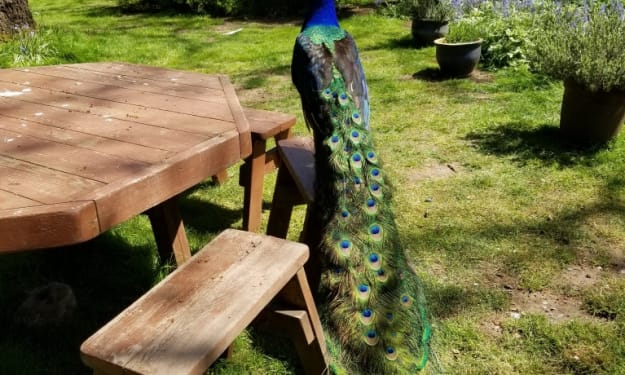
This is my pet peacock Kiwi. He is a very sweet gentle bird. He likes to eat bugs and leaves. He also likes to sleep in my black walnut tree. Every night he flies up into the tree and sleeps. During mating season his tail grows long, up to five feet and he shows it off to the pea hens. I raised this bird from a small little peachick. If you visit a local zoo let's say the Oregon Zoo. They have many peacocks who can be very aggressive, this is due to be pestered by every 3 year old that visits the zoo. Peacocks don't take kindly to harassment.
By peachick 8765 years ago in Petlife
A Gathering of Evil Bosses
“I’m the queen of chin jutting while I smooth my hair, attacking, insulting, and deflecting to protect my appointer.” “Oh, please, Blondi, my hair is curled, highlighted, and longer than yours. I feature television commercials telling immigrants that we will give them a free plane ride home, and if they voluntarily turn themselves in, they will be allowed to legally apply for re-entry. It runs everywhere, and I look good in it! You can’t compete because of your blond hair. Mine is nicer, and my lips are prettier than yours.”
By Andrea Corwin 17 days ago in The Swamp
The Last Time a U.S. Navy Submarine Sunk an Enemy Ship in Combat
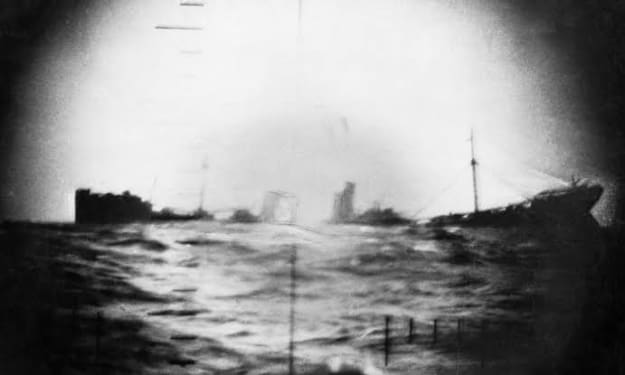
The U.S. Navy’s submarine force is among the most powerful and secretive elements of America’s military, but in the nearly 80 years since World War II, its boats have rarely been called on to directly sink enemy ships in combat. The last confirmed instance of an American submarine sinking an enemy vessel in open wartime conditions occurred during the Gulf War in 1991, when a Los Angeles‑class nuclear‑powered fast attack submarine engaged and destroyed an Iraqi Tench‑class patrol ship in the northern Arabian Gulf. That action — swift, precise, and largely unheralded at the time — marked the closing chapter of a long tradition of submarine warfare that had its most intense chapters during the Pacific campaigns of World War II. Since then, strategic deterrence, surveillance, intelligence gathering, and special operations support have become the primary missions of U.S. submarines, even as their weaponry and reach have grown far more capable. The 1991 Engagement: Submarine Combat in the Gulf In January 1991, during Operation Desert Storm, the United States and coalition forces launched a massive campaign to expel Iraqi forces from Kuwait after Saddam Hussein’s invasion of 1990. The conflict featured overwhelming air and ground power, but the U.S. Navy’s submarines also played critical roles in controlling littoral waters, collecting intelligence, and denying the Iraqi military freedom of movement. The submarine USS Baton Rouge (SSN‑689), a Los Angeles‑class fast attack boat, was operating in the northern Arabian Gulf when it detected an Iraqi patrol ship attempting to harass coalition vessels. Using its sophisticated sonar and combat systems, the submarine tracked the target and made the decision to engage under established rules of engagement governing wartime operations. At approximately 3 nmi from the target, Baton Rouge fired a Mark 48 torpedo, the same heavyweight anti‑ship/anti‑submarine weapon that remains a staple of U.S. submarine armament today. The torpedo struck the Iraqi patrol ship, which rapidly sank. There were no U.S. casualties, and the action was completed without broader escalation — reflecting both the tactical precision and strategic restraint that characterise modern U.S. submarine warfare. Though this engagement marked the last official sinking of an enemy warship by a U.S. submarine in direct combat, submarines continued to contribute significantly in other ways throughout the Gulf War and in subsequent conflicts, including launching Tomahawk land‑attack cruise missiles and supporting special forces. From World War II to the Gulf: The Evolution of Submarine Warfare The submarine’s role in combat was drastically different during World War II, when they were at the vanguard of naval warfare in both the Atlantic and Pacific Theatres. In the Pacific, U.S. submarines targeted Japanese shipping relentlessly, contributing to the isolation and eventual defeat of Japan by cutting supply lines and sinking warships and merchant vessels alike. By contrast, the late 20th‑ and early 21st‑century conflicts have seen submarine operations geared more toward deterrence, power projection, and precision strike. Nuclear‑powered submarines now conduct intelligence, surveillance, and reconnaissance (ISR) missions and carry Tomahawk missiles capable of striking targets thousands of miles inland — making traditional surface engagements rarer. The Modern Strategic Context Today’s submarines remain among the most advanced weapons systems in the U.S. arsenal. The latest Virginia‑class attack boats combine stealth, long endurance, and multi‑domain strike capabilities. Yet direct surface engagements like the one in 1991 are unlikely to be common. Modern naval strategy emphasises deterrence and precision fires, using submarines to gather information, conduct covert operations, and strike land targets rather than to seek out enemy ships. The changing character of naval combat also reflects broader geopolitical shifts. Many potential adversaries lack significant surface fleets, focusing instead on missile systems, submarines of their own, or asymmetric sea denial strategies. When surface combat occurs in future conflicts, the consequences — including civilian harm and escalation — will also weigh on commanders’ decisions about whether and how to engage. Why the 1991 Engagement Still Matters The action in the northern Arabian Gulf remains significant for several reasons: Historical continuity: It was the last time an American submarine sank an enemy warship in traditional naval combat. Tactical precision: The engagement demonstrated the ability of submarines to strike decisively and safely in crowded littoral waters. Strategic restraint: The action was tightly controlled, aligning with broader military objectives without triggering disproportionate escalation. Submarines today may seldom end their missions with a sunken enemy ship on the bottom of the sea, but their impact on global security is no less profound. From ballistic missile deterrence to covert ISR and land‑attack missions, the silent service continues to shape strategic outcomes in ways that often remain invisible to the general public. If future conflicts bring renewed surface engagements, lessons from the 1991 Gulf War action — precision, restraint, and integration with broader strategy — will inform how submarine commanders act. Until then, the sinking by Baton Rouge stands as the most recent chapter in a long and storied tradition of U.S. submarine warfare.
By Fiaz Ahmed 2 days ago in The Swamp


Comments
There are no comments for this story
Be the first to respond and start the conversation.