
The Neo-Nazi Propaganda Machine
Trump is coming raving his own rise to a dictatorship. #twitler

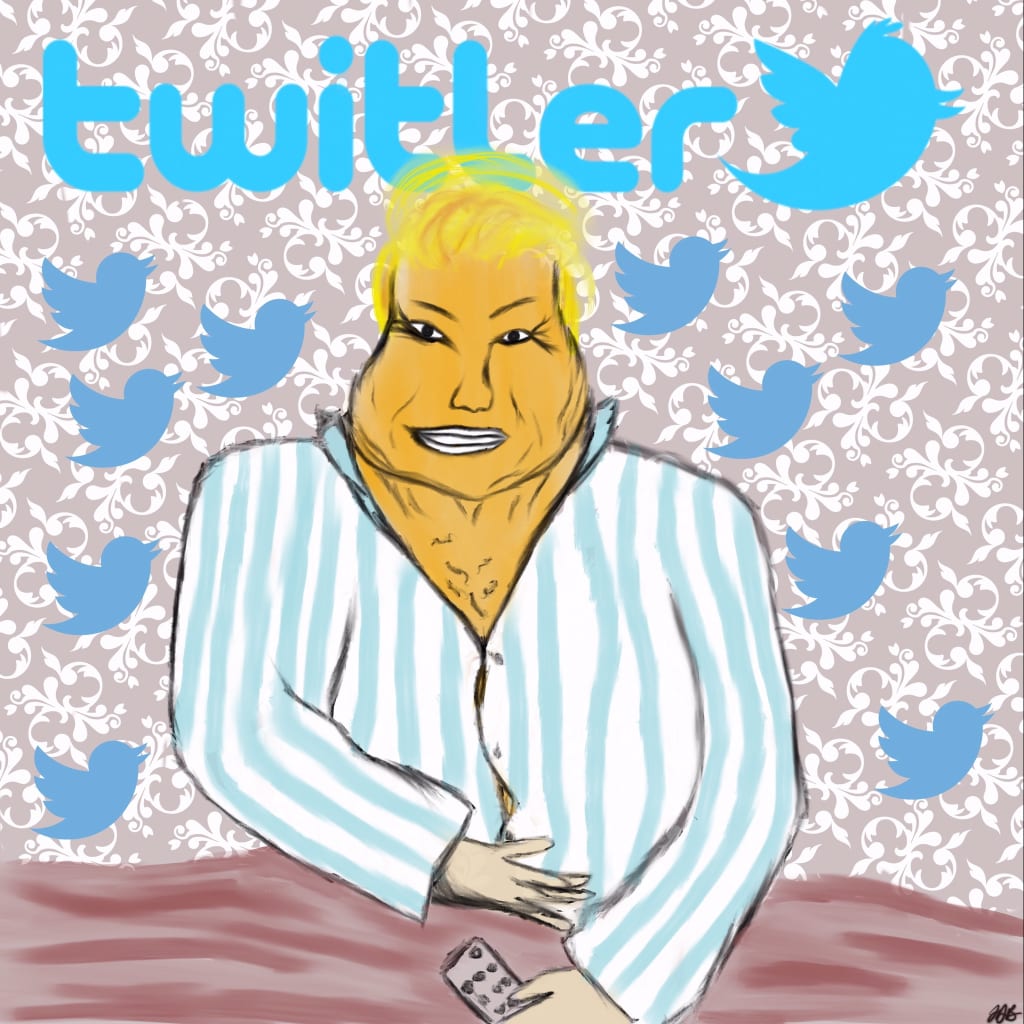
We are allowing too much freedom of pushing his boundaries to this president.
Point blank. Between his executive orders and the most important thing to me to express in this article, his Neo-Nazi Propaganda Machine. Little Twitler has become a lying and verbally demeaning sensation as well as one of the best jokes on the internet.
A president tweeting about television shows in negative ways and mistreating the media, citizens, war heroes, civil rights leaders, women, actors/actresses, and other political figures is detrimental to the meaning of the presidency. It makes you look like a grump old bastard voicing your opinion over social media because no one really cares about it otherwise. You are embarrassing our country Donald J. Trump.
It would be a little better if your claims and assaults were based on facts and not some made up "alternative facts" in your head. You can't make up what is fact. The presidency does not make you God. It does not give you the ability to assault people verbally, even if that's your normal style of life. That must end here. You must respect us as Americans and shut down your personal twitter. We willingly employ a social media team for you for a reason. So we do not look like you currently do. Please, at least if your going to work against all of us that support everything in your opposition all four years of this dark time, at least do it with grace and dignity. Please respect the office your sitting in because every man before you was one of the greatest Americans of their time that worked so hard to create a better America for EVERY person. To build on what we have, and not to tear down protections for some.
Please remember this and maybe it will create you a better mindset as you destroy everything we believe in with your pen and twitter account on a late night with Steve Bannon, talking locker room talk about Ivanka.
Follow me on Instagram or Twitter for the latest updates on articles.
Instagram.com/drewx_o
Twitter.com/drewx_o
About the Creator
Megan Bradford
Creative.
Activist.
Unique.
Unique.
Follow me on Instagram for the latest updates. @x_o.Megan
Keep reading
More stories from Megan Bradford and writers in The Swamp and other communities.
#CALEXIT, Leaving a Nation
If you've read my work before you'll know I'm a recent California migrant, coming from the beautiful state of Alabama. As you'll also know I love my new home state more than anyone will ever understand until they find their own home state. Yes, moving to Los Angeles was a culture shock. I learned and adapted and I love the way of life in this huge city, and beautiful state. With the recent development of the #CALEXIT idea, I would like to say several things. First of all, I cannot be prouder to say this is my home state and I love they stand for everything I believe in. California has showed me the greater side of America's openness, in my opinion. With this being the development at hand, I will say I fully agree with California seceding from the union to create a nation it bases on the beliefs we set forward currently as a state.
By Megan Bradford9 years ago in The Swamp
Why Black History Matters in America?
The United States of America is celebrating their 250th anniversary in 2026. I'm proud to be an American and as someone who was born here, I wouldn't imagine myself living anywhere else. This is a country where opportunities are possible. Where anyone can be successful in anything they desire to do. Equality, community, and togetherness are the backbones of what America is and should be about. However, we have an administration who wants to erase and disregard those who have made positive, meaningful impacts in our country, specifically Black figures, such as Martin Luther King, Jr., Rosa Parks, and Maya Angelou. President Trump and his administration have been constantly complaining and fighting against what they call the "Woke agenda". They use this excuse as a distraction from other issues they refuse to address, such as the high cost of living, climate change, and inflation. That equality is dividing America, when in reality, it's bringing us together. Being woke is not tied to a specific political party. No matter where you stand on the political spectrum, you can still care about other people and their plights. Compassion and empathy for others isn't tied to a political party, either. We were taught as children to treat others the way we want to be treated and not judge others because they're different from us. Caring about others isn't a personal attack on your beliefs. It doesn't make you any less of a person. People who are easily offended over African American figures, past or present, or anything related to it, are grasping at straws. Current and future generations need to know who people like Harriet Tubman and Shirley Chisholm were, especially in the classroom. Black History is part of American History. It should be recognized, not hidden or forgotten. Besides, you can't shield children from everything, just because your feelings are easily hurt.
By Mark Wesley Pritchard 29 days ago in The Swamp
Here Are The 10 Most Powerful Air Forces in the World in 2025 – And France Is Second to Last
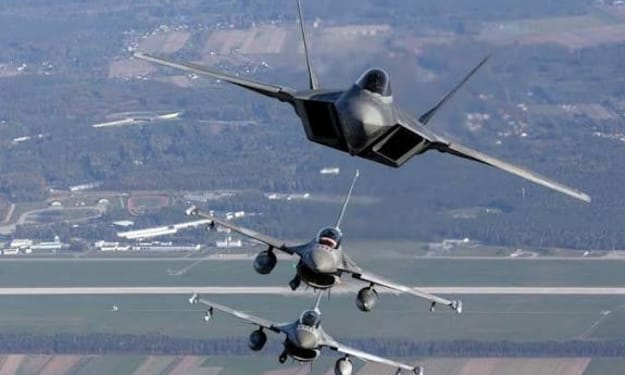
As global military technology continues to evolve, the ranking of the world’s most powerful air forces has shifted dramatically in 2025. Military analysts have assessed air forces based on a combination of fleet size, technological sophistication, readiness, operational experience, and strategic reach. The results reveal significant disparities between nations, with some long-standing military powers retaining dominance, while others, including France, surprisingly lag behind despite their historical military reputation. At the top of the list is the United States Air Force (USAF), which continues to maintain an unmatched edge in technology, global reach, and operational readiness. The USAF’s fleet of fifth-generation stealth fighters, including the F-22 Raptor and F-35 Lightning II, along with advanced bomber aircraft such as the B-2 Spirit and the B-21 Raider, provides the United States with unmatched aerial dominance. Coupled with a global network of bases, satellite reconnaissance, and rapid deployment capabilities, the U.S. remains the uncontested leader in air power. Second on the list is China, whose People’s Liberation Army Air Force (PLAAF) has grown rapidly in both size and sophistication. China has invested heavily in stealth fighters, such as the Chengdu J-20, and has expanded its strategic bomber capabilities with aircraft like the Xian H-20, reflecting the nation’s ambitions to project air power regionally and globally. The PLAAF has also developed advanced drone programs, hypersonic weapons, and integrated electronic warfare capabilities, making it a formidable opponent in any potential conflict scenario. Third place is held by Russia, which continues to maintain a strong air force with a focus on both quantity and quality. The Sukhoi Su-57 stealth fighter and modernized versions of the Su-35 provide Russia with a credible air combat capability. Additionally, Russia’s strategic bomber fleet, including the Tu-160 and Tu-95, enhances its long-range strike potential. While Russia faces challenges in logistics and modernization, its operational experience and robust defense industry keep it among the top air powers. Other countries in the top ten include India, Japan, Israel, South Korea, Turkey, and the United Kingdom, each demonstrating a mix of advanced aircraft, operational readiness, and domestic aerospace production capabilities. India and Japan have heavily invested in modern fighters and domestic production programs, while Israel is known for its highly trained pilots and integrated defense networks. South Korea and Turkey balance modern Western aircraft with indigenous upgrades, while the UK leverages its nuclear deterrent and fifth-generation fighter capabilities. Surprisingly, France, traditionally regarded as a military power with one of Europe’s most advanced air forces, ranks second to last in the 2025 assessment. Analysts point to several factors contributing to France’s low ranking. Although France possesses modern aircraft such as the Dassault Rafale, the air force suffers from limited fleet size, aging support systems, and budget constraints that restrict large-scale modernization. Additionally, France’s global deployment capacity is constrained compared to the U.S., China, or Russia, limiting its strategic reach. While operationally competent and technologically advanced, France’s air force cannot match the scale or depth of its global rivals. Several key takeaways emerge from the 2025 ranking. First, technological sophistication alone does not guarantee top ranking; fleet size, maintenance, training, and logistical support play equally important roles. Second, countries investing in domestic aerospace programs, such as China and India, are gaining strategic advantages by reducing reliance on foreign suppliers. Third, nations with limited defense budgets may struggle to maintain parity with more resource-rich powers, regardless of technological competence. Experts suggest that France’s position should not be interpreted as an immediate strategic weakness. Its air force remains capable for regional operations, NATO missions, and nuclear deterrence. However, the ranking highlights the increasing importance of scale, industrial capacity, and integrated technology in defining air power in the 21st century. In conclusion, the 2025 assessment of the world’s most powerful air forces reflects the shifting balance of global military power. While the U.S. continues to dominate, emerging powers such as China and India are rapidly advancing, and traditional European powers, including France, face challenges in maintaining competitive edge. The rankings underscore that in modern warfare, a combination of technological innovation, fleet size, strategic reach, and industrial capability determines the strength of a nation’s air force.
By Fiaz Ahmed about 23 hours ago in The Swamp



Comments
There are no comments for this story
Be the first to respond and start the conversation.