
What Really Happened at Trump’s Rally Today?
The Chants, The Claims, and the Quiet Part No One’s Talking About

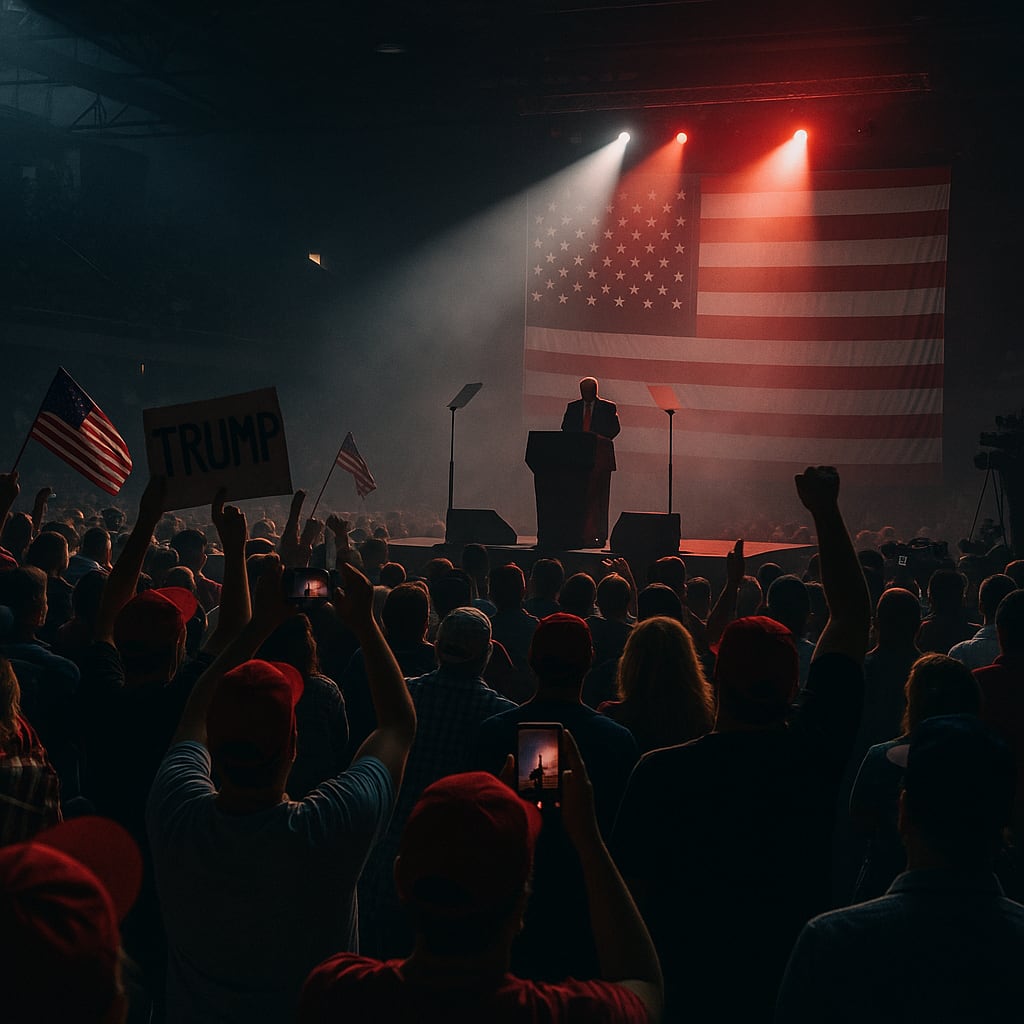
Inside the noise, the spin, and the uncomfortable truth about where this all goes next
By the time Trump walked on stage, the air already felt heavy.
Not metaphorically. Literally.
It was that thick, recycled arena air, warm from too many bodies and too much waiting. People had been standing for hours—red hats smudged with sweat, folding chairs pushed into crooked rows, homemade signs leaned against their owners’ legs like tired pets.
On one side, a woman in her 60s clutched a “TRUMP OR DEATH” flag like it was a family heirloom. On the other, a kid barely out of high school wore a shirt that said “MAGA Youth” and kept refreshing his phone, scrolling through TikTok clips of rallies from years ago, like he was studying an old religion.
And in the middle of all of that, you could feel the question humming beneath the music and the merch and the slogans:
What exactly are we doing here?
Not just “here” as in this rally, on this day.
Here as in this moment in American politics, where one man’s microphone keeps drowning out everyone else’s reality.
That’s what I went to find out—or at least to see more clearly—at Trump’s rally today. And what happened on that stage went far beyond the headlines that will slice it into soundbites by morning.
It was part performance, part grievance therapy session, part warning.
And the most unsettling parts weren’t always the loud ones.
The Rally Floor: Hope, Anger, and the Awkward Small Talk Between Strangers
The first thing you notice at a Trump rally isn’t the stage.
It’s the parking lot.
Trucks lined up like a tailgate, flags mounted on poles that look like they could survive a hurricane. Vendors selling shirts from card tables—“Trump 2024: Because F*** Your Feelings”—next to bootleg stands offering pins with his face photoshopped onto a bald eagle.
There’s a strange mix of carnival and funeral.
People are laughing, taking selfies, making small talk about gas prices and grocery bills. Then, without warning, someone will bring up “the stolen election” or “Biden’s open borders,” and the mood shifts. You can feel it—a tightening, a shared understanding that something precious was taken, or at least that’s how they see it.
I ended up in line next to a retired electrician who told me, almost apologetically, “I wasn’t political before 2016. I just worked. Now I feel like the country’s sliding off a cliff and nobody in D.C. cares.”
You can argue with his facts, and we’ll get to those, but you can’t argue with that feeling.
That sense of being ignored.
That’s the emotional fuel that fills the arena long before Trump starts talking. By the time the speakers blast the familiar playlist—“Hold On, I’m Comin’,” “YMCA,” “Macho Man”—the crowd is already half-hypnotized, primed to hear someone say out loud what they’ve been screaming at their TV.
And no one does that, for them, like he does.
The Entrance: A Campaign Event That Feels More Like a Comeback Tour
When the music shifts and the announcer’s voice booms through the speakers, there’s this ripple that spreads through the crowd, like static electricity starting at the edges.
People stand up without being asked. Phones rise in the air in unison. Some people clap. Others put their hands over their hearts, even though this isn’t the national anthem.
The story of the rally really starts here.
Because Trump doesn’t just walk onstage. He appears as if he’s stepping into a role he’s been rehearsing for decades.
He does the familiar gestures: the wave, the thumbs up, the chin lifted just enough to look defiant, not grateful. The crowd roars like they’re greeting a survivor, not a candidate.
And that’s a key part of how this rally is framed.
This isn’t just “Trump versus Democrats” anymore. It’s “Trump versus the system,” “Trump versus the deep state,” “Trump versus the media,” “Trump versus the cases,” “Trump versus the world.”
In his telling, every indictment is proof. Every investigation is validation. Every legal consequence is just another way the powerful are trying to silence the man speaking “truth.”
You can watch the story lock into place like a puzzle in real time.
He raises his hand, the crowd quiets just enough, and then the show begins.
Key Moment #1: The Election Claims That Still Won’t Die
Nearly every Trump rally has a greatest hits set, and the “stolen election” narrative is the song that never leaves the playlist.
Today was no different.
At one point, after a riff about “Biden’s weakness” and “America’s decline,” he slipped into it:
“We won in 2016. We won even bigger in 2020. Everybody knows it. They cheated, they rigged it, and they’re trying to do it again.”
The crowd responded instantly.
“Stop the steal!” a section near the front began chanting, even now, years later. It spread, echoing through the arena, and for a moment you could almost forget that the legal system, state election officials, and Trump’s own appointees have repeatedly said the opposite.
Here’s what doesn’t get said from that stage:
More than 60 post-2020 election lawsuits filed by Trump and his allies failed in court. Judges—including some he appointed—said there wasn’t evidence to support the claims.
Trump’s own Department of Homeland Security called the 2020 election “the most secure in American history.”
Republican officials in states like Georgia and Arizona publicly refuted the fraud allegations, sometimes at great personal cost.
None of that makes it into the rally script.
Reality, in this setting, is not a shared space. It’s a negotiated one.
If the facts don’t match the story, the facts are dismissed as corrupt. And the crowd doesn’t just accept that—they demand it.
You can hear it in the way people around you talk: not “if” the election was stolen, but “how badly.”
There’s no room left for doubt.
And once doubt is gone, so is the possibility of a peaceful loss.
Key Moment #2: The Crime and Immigration Lines That Land Like Punches
If the election talk is the emotional core, crime and immigration are the accelerants.
Trump leaned into both, hard.
He painted a picture of American cities as war zones: “Our streets are overrun with criminals. People are afraid to go to the store. They’re afraid to walk to church.”
It’s vivid. It’s scary. It’s also not quite that simple.
Are crime and safety real concerns? Yes.
But overall, violent crime in the U.S. dropped in 2023, according to FBI data, including homicides in many major cities. The story on the ground varies by neighborhood and city, but it’s not the uniform spiral he describes.
Then came immigration.
He called the border “a bloodbath.” He claimed “millions of criminals” are pouring in, that “they’re emptying their prisons and mental institutions and sending them here.”
Here’s what the data says:
A large portion of migrants are families and asylum-seekers fleeing violence and poverty.
Studies over many years have consistently shown that immigrants, including undocumented immigrants, are less likely to commit crimes than native-born citizens.
The system is overwhelmed, yes. The border is strained, yes. But the blanket image of “invading criminals” doesn’t match the full reality.
Listening to him, though, you wouldn’t know any of that.
He speaks in absolutes, not shades of gray.
And in that arena, those absolutes land like truths, because they match the fear people already feel—fear of change, fear of losing control, fear that the country they grew up in is slipping away from them.
When he says, “They’re not sending their best,” the crowd nods, not because they’ve studied immigration statistics, but because the line rhymes with their anxiety.
Facts become almost secondary.
Emotion is the organizing principle.
Key Moment #3: The “Jokes” That Aren’t Really Jokes
There’s always a stretch in the rally where Trump shifts into stand-up mode.
Today, he mocked Biden’s age and stumbles, mimicked reporters’ voices, and tossed out one-liners about his legal troubles.
People laughed. Really laughed.
On the surface, it almost feels light.
But beneath the jokes, he says things you’d expect from someone who doesn’t see limits anymore.
He talked about how, if he wins, “we’re going to clean house” in the federal government. He suggested going after political enemies with investigations of his own.
He hinted—sometimes openly, sometimes with that knowing smirk—that the system is so rigged, it might take “extraordinary” measures to fix it.
When he calls the media “the enemy of the people,” it’s not new. But hearing a crowd of thousands boo and curse at a press section fenced off in the back never stops feeling unsettling.
I watched a teenage girl flip off the reporters while her dad laughed and took a photo like it was a family joke.
None of this is accidental.
The humor makes the harsh lines more palatable. The crowd can tell themselves he’s “just joking” if it ever goes too far… unless it doesn’t feel too far to them.
And that is the uncomfortable part: the way the laughter softens the edges around ideas that, stripped of the jokes, would sound like open contempt for any system that doesn’t bend to him.
What Fact-Checking a Rally Like This Actually Feels Like
It’s easy to imagine fact-checking as some clean, clinical process: claim vs. truth, false vs. true, stamp it and move on.
Inside the rally, it feels nothing like that.
Every time Trump makes a claim—a giant wall completed, gas prices “ten times higher,” NATO “destroyed,” Democrats “killing babies after they’re born”—there’s this instinct to grab your phone and Google it, to anchor yourself in something verifiable.
Most of the time, you find that:
The wall is partially built, not complete, and large sections never happened.
Gas prices did rise post-pandemic and after Russia’s invasion of Ukraine, but not to “ten times higher,” and they’ve fluctuated since.
NATO was strained under his presidency but not destroyed; in fact, Russian aggression has pushed many countries closer together.
The “killing babies after birth” line is a distortion of debates over late-term abortion and medical care in extreme cases, not actual infanticide.
But here’s the catch: very few people inside that rally are fact-checking in real time.
They’re cheering, booing, chanting, recording.
They’re responding emotionally, not analytically.
And you start to realize the real gap isn’t just about facts. It’s about information ecosystems.
If your news diet is built primarily on Trump’s speeches, a handful of sympathetic outlets, and social media accounts that amplify them, the world he describes doesn’t feel like a lie. It feels like a perfectly coherent universe.
Fact-checks from outside that universe sound less like clarity and more like an attack.
So when people say, “How can anyone believe this?” the answer is uncomfortably simple:
Because it’s the only story they’re hearing that acknowledges their anger and gives them a hero.
A flawed hero, sure. But a hero who says, “They’re not just wrong. They’re screwing you on purpose.”
That narrative is powerful. Facts alone don’t break it.
The Moment It Got Quiet: Fear, Future, and a Line That Hung in the Air
Toward the end of the rally, after the big applause lines and the familiar chants, Trump’s tone shifted.
He dropped his voice slightly, leaned into the microphone, and said something along the lines of:
“If we don’t win this time, I don’t know if we’ll have a country left.”
You could argue that’s just typical campaign exaggeration.
But in the room, it landed like something heavier.
People around me stopped talking. One woman started crying quietly. A man near the aisle shook his head slowly and said to no one in particular, “He’s right. This is it.”
That’s the emotional knife-edge this whole movement sits on now.
This isn’t just about policy differences or partisan squabbles. It’s about existential fear.
For many of the people in that arena, a Trump loss isn’t just disappointing—it’s the end of the America they recognize. He’s told them that. Repeatedly. And they’ve built their sense of political reality around it.
If you believe the system is hopelessly rigged…
If you believe your vote can be stolen…
If you believe the other side wants to destroy your way of life, not just debate it…
Then what happens if he loses again?
That’s the question that kept echoing in my head on the way out.
Not the polling numbers. Not the fundraising totals. Not even the legal strategy.
What happens to a country where millions of people have been told that any outcome other than one man’s victory is illegitimate?
What Comes Next: Beyond the Headlines and the Hashtags
Walking out of the arena, the temperature dropped, but the noise didn’t.
People streamed back to their cars, still arguing about the border, the economy, “woke” schools, and whether there would be “another January 6th” if things “went sideways” again.
One guy laughed when his friend brought it up and said, “They ain’t seen nothing yet,” but the look in his eyes didn’t fully match the joke.
And here’s the part that’s been sitting with me since:
The rally will be chopped into clips by morning.
Cable news will play the most outrageous lines on repeat. Social feeds will be flooded with half-quoted claims, applause moments, cherry-picked crazy signs.
The arguments will follow the same tired script:
“He lies constantly.”
“At least he’s honest about what he thinks.”
“He’s a threat to democracy.”
“They’re the real threat to democracy.”
We’re good at fighting about Donald Trump.
We’re less good at facing what’s actually happening to us around him.
Because no matter how you feel about him personally, the reality is this:
There is a growing chunk of the country that no longer trusts elections unless their side wins.
There is a deepening belief that institutions—from courts to media to universities—are hopelessly corrupt.
There is a political incentive, on all sides, to keep people angry, scared, and glued to the drama.
Trump didn’t invent that.
But he’s mastered how to harness it.
Rallies like the one today aren’t just campaign events. They’re rituals that reinforce a worldview where compromise is betrayal and losing is impossible unless someone cheated.
That’s the real story.
Not just what he said, but what people heard—and what they’re going to carry back home to their group chats, their family dinners, their local Facebook groups.
The question isn’t just: What happened at Trump’s rally today?
The question is: What are we going to do, collectively, with the country that walks out of arenas like that one?
I don’t have a neat answer.
What I do know is this:
If we keep treating these rallies as just spectacles to mock or headlines to doomscroll past, we’re missing the point.
There are real people in those seats—scared, angry, hopeful, and yes, sometimes misled. But they’re not going anywhere. Neither are the people who are terrified of Trump coming back.
We all still have to live in whatever’s left after this election cycle is over.
So maybe the next time a Trump rally trends, instead of only asking, “How can they believe this?” we start asking harder questions:
Who benefits from us hating each other this much?
What would it take to build something that doesn’t require a cult of personality to feel heard?
And what part of this mess are we each willing to own, instead of just pointing at our chosen villain and calling it a day?
Because if there’s one thing today’s rally made painfully clear, it’s this:
No matter who wins or loses, we’re already in deeper than most of us want to admit.
About the Creator
abualyaanart
I write thoughtful, experience-driven stories about technology, digital life, and how modern tools quietly shape the way we think, work, and live.
I believe good technology should support life
Abualyaanart
Keep reading
More stories from abualyaanart and writers in The Swamp and other communities.
A Gathering of Evil Bosses
“I’m the queen of chin jutting while I smooth my hair, attacking, insulting, and deflecting to protect my appointer.” “Oh, please, Blondi, my hair is curled, highlighted, and longer than yours. I feature television commercials telling immigrants that we will give them a free plane ride home, and if they voluntarily turn themselves in, they will be allowed to legally apply for re-entry. It runs everywhere, and I look good in it! You can’t compete because of your blond hair. Mine is nicer, and my lips are prettier than yours.”
By Andrea Corwin 7 days ago in The Swamp
Iran Wants Deal Apparently!!!
Protests have flared up again over the weekend in Iran. As the university term started, students gathered on campuses to protest the regime and show their support for it. This time, these protests are not as great as the ones in January. Some thought the clerical regime could be swept away as the Shah's regime was in 1979, which led to the rise of the Ayatollahs.
By Nicholas Bishop2 days ago in The Swamp
At My Wits’ End
Life is about taking out the trash and calling it trash because you have every reason to. It wasn't meant to be linear, they say. But the times you tried to make it straight led to problems, and you didn’t have the tools to put any of it to use. You don't put your right shoes on the right feet; you put the left shoes on the left feet. The grey hardened slab will trip you up anyway.
By Caitlin Charlton7 days ago in Humans


Comments
There are no comments for this story
Be the first to respond and start the conversation.