
Share a Not a crash, Not a big loss experience.
Stock Experience: From Newbie to Professional (5)


Alright.
This time, I’ll share a different kind of experience.
Not a crash.
Not a big loss.
But something that quietly changes a trader forever:
The first time trading with 10x larger capital.
This is the stage where many technically good traders fail — not because their strategy stops working, but because their psychology cannot handle the size.
The Transition: From Small Capital to Serious Capital
For years, I traded relatively small size.
Loss of –1R felt manageable.
Drawdowns were numbers on screen.
Execution was mechanical.
Then capital increased significantly.
Not double.
Not triple.
Ten times larger.
Same strategy.
Same charts.
Same setups.
But completely different emotional weight.
Because now:
A –1R loss wasn’t “uncomfortable.”
It was equivalent to months of normal salary for many people.
And that changes your nervous system instantly.
The First Trade With Larger Size
The setup was perfect.
Strong base.
Volume expansion.
Sector leadership aligned.
Index supportive.
On the VNIndex, structure was healthy.
Everything aligned exactly like dozens of previous winners.
I entered with full planned risk.
Within 30 minutes:
Position moved –0.5R.
Normally, that is noise.
But this time?
Heart rate increased.
Because the monetary fluctuation was large.
The chart didn’t change.
But perception did.
The Psychological Distortion
When capital grows, perception of volatility changes.
A normal pullback feels violent.
A normal red candle feels threatening.
You start micro-managing entries.
Watching every tick.
Lower timeframe noise suddenly matters.
Before, I looked at daily structure calmly.
Now I zoomed into 5-minute chart.
That’s when I realized:
Capital size exposes emotional maturity.
The First Mistake
Price recovered and turned green.
Up +1R.
Instead of letting it run toward 2R target,
I took profit early.
Because profit felt “too big.”
This is a subtle psychological trap:
You cut winners early
because gain feels unreal.
Losses feel heavy.
Profits feel fragile.
That imbalance destroys expectancy.
The Second Trade: Fear of Loss
Next setup came.
Equally strong.
But I reduced size by 40%.
Not based on market condition.
Based on fear.
Trade worked beautifully.
Ran 3R.
But because I sized down emotionally,
actual return was smaller than it should be.
That created frustration.
Now two emotional distortions appeared:
Cutting winners early.
Reducing size randomly.
Both came from capital pressure.
The Deep Realization
Your strategy does not scale automatically with capital.
Your psychology must scale too.
Most traders focus on:
Entry quality
Risk-reward ratio
Win rate
But few prepare for:
Capital growth shock.
Because when numbers become meaningful,
decision quality can degrade.
The Hidden Danger: Identity Shift
When trading small,
you think like a learner.
When trading large,
you start thinking like:
“I must protect this.”
That protective mindset can create over-defensive trading.
Too tight stops.
Too early exits.
Too little participation.
Ironically,
fear of losing capital prevents capital growth.
The Solution: Risk in Percent, Not Money
To fix this,
I went back to basics.
I removed currency value from screen.
Only percentage risk visible.
1% is 1%.
No matter account size.
That helped normalize perception.
Because brain reacts to absolute numbers strongly.
But percentage keeps logic intact.
The 10x Pressure Effect
Here’s something important:
Emotional pressure increases faster than capital.
If capital increases 10x,
emotional pressure feels like 20x.
Because:
Responsibility increases.
Fear of losing gains increases.
Identity attachment increases.
If you don’t adjust mentally,
you self-sabotage.
The Maturity Breakthrough
After months of adjustment,
I built new internal rules:
Same risk model regardless of capital.
Same execution criteria.
No intraday micromanagement unless planned.
No early exit unless structure breaks.
I forced myself to treat capital as inventory.
Not personal money.
Inventory for business.
That mental framing reduced emotional spikes.
The First True Large Winner
Months later,
a clean trend emerged.
Banking sector led strongly.
Index confirmed.
I entered properly sized position.
Trade ran 4R over weeks.
This time,
I did not cut early.
I followed trailing structure.
Emotion still present,
but controlled.
That trade compensated previous hesitations.
More importantly,
it rebuilt confidence at higher capital level.
The Core Lesson
Trading bigger size doesn’t require better strategy.
It requires stronger emotional discipline.
If you can trade small account consistently,
you can trade large account —
Only if you control psychological scaling.
Most traders fail not at strategy stage.
They fail at scaling stage.
Vietnam Market Specific Challenge
In VNIndex cycles,
volatility can expand suddenly.
A 3–4% index move in days is common.
When trading large capital,
that volatility feels intense.
If you’re not mentally prepared,
you exit too early or freeze too long.
Scaling requires:
Accepting volatility as normal.
Trusting system over emotion.
Detaching identity from capital size.
The Final Truth About Bigger Money
Small account teaches skill.
Large account tests character.
Skill gets you profitable.
Character keeps you consistent.
When you increase capital,
don’t change system first.
Upgrade mindset first.
Because at higher level,
technical mistakes are rare.
Emotional mistakes are expensive.
About the Creator
Zidane
I have a series of articles on money-saving tips. If you're facing financial issues, feel free to check them out—Let grow together, :)
IIf you love my topic, free feel share and give me a like. Thanks
https://learn-tech-tips.blogspot.com/
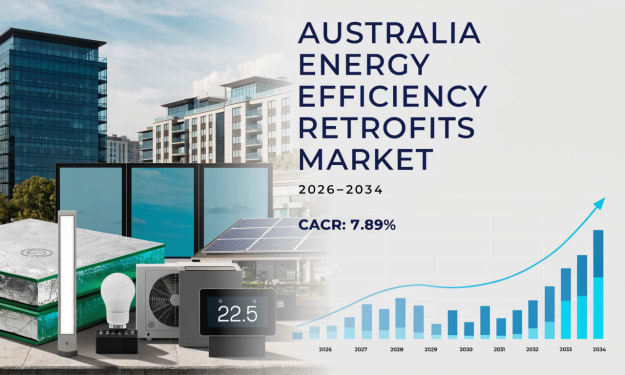
Australia Energy Efficiency Retrofits Market 2026: Decarbonisation Goals, Smart Building Upgrades and Sustainable Infrastructure
Australia Energy Efficiency Retrofits Market Overview Australia’s energy efficiency retrofits market is gaining strong momentum as the country accelerates its transition toward low-carbon infrastructure and sustainable building practices. Retrofitting existing buildings with energy-efficient technologies — including insulation, lighting upgrades, HVAC improvements and smart energy management systems — has become a critical strategy for reducing energy consumption and operational costs. With a large share of Australia’s building stock constructed before modern efficiency standards, retrofit solutions offer substantial potential for emissions reduction and energy savings across residential, commercial and industrial sectors.
By Amyra Singh7 days ago in Trader
United Kingdom Diabetes Devices Market Size and Forecast 2026–2034
United Kingdom Diabetes Devices Market: An Expanding Healthcare Priority The United Kingdom diabetes devices market is entering a phase of steady and technology-driven expansion, reflecting both the rising burden of diabetes and the healthcare system’s growing emphasis on early diagnosis, continuous monitoring, and long-term disease management. According to Renub Research, the market is expected to grow from US$ 1,214.80 million in 2025 to US$ 2,333.50 million by 2034, registering a compound annual growth rate (CAGR) of 7.53% from 2026 to 2034.
By Sakshi Sharma5 days ago in Trader
Tatt~Master
— Assembly Line Tatt Machine ~ Impressions to Impress — As I begin to understand more about the Tattoo Phenomenon. I've written silly, yet verbatim, dating site anecdotes in 'Frazzled.' So let me ask you: Would you be More attracted to someone slathered with tattoos, or Less?
By Jay Kantorabout 11 hours ago in Humor



Comments
There are no comments for this story
Be the first to respond and start the conversation.