
The goddess of ten thousand names.
Exploring the many faces of femininity and how every woman defines her own.


I wanted to write about the goddess Isis for some time now, but felt like my understanding of her is too limited, and my perspective won’t do this powerful archetype a justice. Mainly because, just like the title of this essay suggests, she was the embodiment of countless archetypes, and I haven’t studied them enough.
And perhaps this is the point — just like Isis carried many expressions of the feminine, so does every woman in her own unique way.
Since today is the 8th of March — International Women’s Day, it feels like a good time to revisit this theme, regardless of the depth of my understanding, which is deep enough to communicate the message.
For thousands of years, up until the last century, the expression of feminine energy in its full range of archetypes was largely suppressed in society. Only certain qualities were considered acceptable for a woman to express, and only certain roles were welcomed — mainly those of a mother and a wife. The rest of the feminine expressions were deemed inappropriate and ended up forming a massive shadow in the collective unconscious, which is a whole other conversation and subject for another post.
Magic, protection of women, death and rebirth, healing, fertility, motherhood — those are some of the powers and attributes embodied by the great Goddess whose name is translated as “Queen of the Throne”. What always inspires me when I look at her visual representation are her wings. The ability to fly while in human form feels like the divine aspect expressing itself despite the perceived limitations of the density of the material world.
Another remarkable aspect of her abilities is expressed in the legend of Osiris, the husband of Isis, who was killed by his brother Seth and brought back from the dead thanks to the love Isis had for him, as well as her magical powers. The major emphasis in this story was made on sexual magic — something largely forgotten in this day and age, but practised in her era and later in the temples of Isis in Ancient Egypt.
Female sexuality became pretty much a taboo during the era of patriarchal monotheistic religions — a very different picture compared to the times of worshipping the Goddess. Again, a lot can be written about this and it still wouldn’t scratch the surface of what can be described as the suppression of the divine feminine energy in both women and men.
On the surface, we see the schism expressed as a “battle of the sexes“ and feminists versus misogynists. But this is only a small part of a much larger picture: these conflicts are consequences, not causes, of a deep and long-standing imbalance between masculine and feminine energies.
What’s more, anyone who embarks on the challenging but rewarding path of healing and self-development very quickly learns that regardless of our gender, we all have both masculine and feminine energies within us. The teachings of Carl Jung on Anima and Animus are a good place to start, although these days there are also many simpler explanations available online.
Speaking of the feminist movement, while it began with good intentions — and we have much to thank it for, I believe that some of its expression has been hijacked along the way, turning at times into a fight against men rather than a reclamation of women’s autonomy. It also sent confusing messages about women and men being the same. While we are equal in our rights, we are not the same, yet feminism sometimes overlooks this distinction while trying to prove that women can do everything a man can do.
To me, this echoes the old paradigm of masculine dominance. From a Jungian perspective, the Animus — the inner masculine in every woman can sometimes exert an unconscious influence. Becoming aware of this allows each woman to consciously integrate both her feminine and masculine energies, and define for herself what femininity truly means.
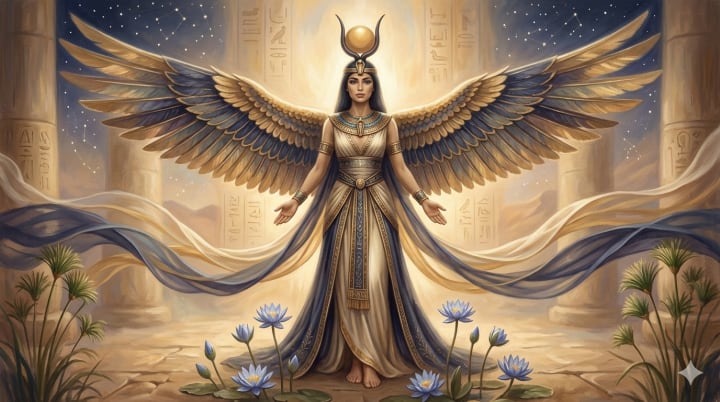
Going back to Isis, she reigned on Earth for a very long time, which might be an additional explanation why her symbolism represents as many things as it does. According to some sources, she was a high priestess in Atlantis before its destruction and later re-established herself in Ancient Egypt. Whether this is true or not, this archetype can teach women a lot about their inherent complexity and beauty — the multifaceted nature of feminine energy, the mystery that is both ancient and modern, and the infinite wisdom and power that expresses itself differently in every woman.
To me personally, this is the deeper reminder behind the Goddess of ten thousand names — that femininity itself cannot be reduced to a single role, definition, or expectation. Each woman discovers and expresses it in her own way.
When the feminine and masculine energies within humanity come back into balance, miracles can happen. And perhaps this is exactly what our planet needs the most right now.
Happy International Women’s Day, ladies. 💜
About the Creator
Eva Smitte
Writer, model, mental health advocate. Instagram @eva_smitte
Reader insights
Nice work
Very well written. Keep up the good work!
Top insight
Excellent storytelling
Original narrative & well developed characters
Keep reading
More stories from Eva Smitte and writers in Viva and other communities.
Beauty- inner, outer and everything in between.
It is a bizarre notion , but what is considered beautiful at any given time in the society, is constantly changing, not unlike the fashion trends. Bizarre, because unlike clothes - people have a soul. Yet, they too are made to feel disposable. If they allow it of course.
By Eva Smitte2 years ago in Viva
How Class Shapes Access to Elite Sports
Elite sports are often portrayed as meritocratic arenas where talent, discipline, and hard work determine success. The dominant narrative suggests that anyone with sufficient dedication can rise to the highest levels of competition. In reality, however, access to elite sports is strongly influenced by socioeconomic class. Financial resources, social networks, institutional access, and geographic location all shape who is able to train, compete, and remain in high-performance pathways. Talent is necessary, but opportunity is unevenly distributed. As a result, class functions as a structural filter that determines which athletes can realistically pursue elite competition.
By Gus Woltmann4 days ago in Viva



Comments (1)
I absolutely love your story it is beautifully written! Your story is so unique and original, it is a master piece. You are one talented writer I really enjoy reading your story. Keep up the good work. Your writing is magical! ♥️🙏