Latest Stories
Most recently published stories in Criminal.
The Crime That Shook Danvers, Massachusetts
The killing of Colleen Ritzer a 24-year-old math teacher at Danvers High School in Danvers Massachusetts remains one of the most tragic and disturbing crimes to affect a school community in the United States in recent years.Colleen Ritzer was widely remembered by colleagues and students as a dedicated and compassionate educator. Early in her teaching career she was known for bringing enthusiasm and patience into the classroom and for taking a genuine interest in the academic and personal wellbeing of her students. Friends and coworkers often described her as someone who believed every student deserved attention, encouragement, and the opportunity to succeed.
By Kure Garba6 days ago in Criminal
Black History Unfiltered
They Believed the Lie—So They Wrote It Into Law by Soul on Fire LEAVIE SCOTT The rumor moved like wildfire because it was designed to. It had the pacing of a ghost story and the precision of a press release. Whispers turned to headlines, headlines turned to hearings, and before long, the lie had grown legs long enough to step into the federal register.
By Organic Products 6 days ago in Criminal
The Digital Gallows
"The clock has struck three, the coffee is cold, and the shadows are beginning to speak. Welcome back to the desk of The Night Writer. Tonight, we’re scrolling through a ghost story written in high-society ledger ink. But be careful—what you find might not be the truth, but the trap."
By The Night Writer 🌙 6 days ago in Criminal
When an Online Affair Turned Deadly
The tragic case involving Sharee Miller her husband Bruce Miller and former investigator Jerry Cassaday is a disturbing story of manipulation obsession and a murder-for-hire plot that ultimately destroyed several lives.Sharee Miller met Bruce Miller while working at his auto salvage yard in Flint, Michigan.Their relationship moved quickly, and the two soon married. On the surface, their life appeared stable, but behind closed doors the marriage was marked by constant conflict and emotional turmoil. Friends and investigators later described the relationship as deeply troubled, with repeated arguments and growing resentment on both sides.
By Kure Garba7 days ago in Criminal
The 1995 Oklahoma City Bombing. Content Warning.
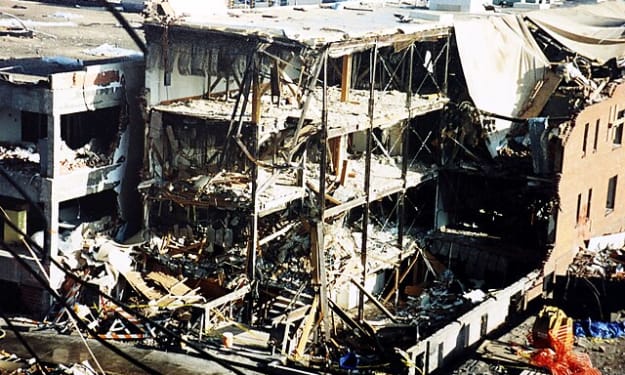
Terrorism and mass shootings no longer shock most Americans. We've heard and seen it all before, more than a few times. Nowadays, we scroll past the post or flip the TV channel without much thought. Perhaps terror attacks are so common that we expect them. We aren't surprised. It hasn't always been this way. There was a time when terror attacks and mass shootings rarely happened. Those rare events shocked people to their core. It left them fearful, yet communal, ready to come together for the betterment of our country.
By Criminal Matters7 days ago in Criminal
He Confessed to Murder in My DMs: The Dark Side of Going Viral
When your most-liked story becomes someone else's confession booth The message came in at 2:13 a.m. I saw the notification glow on my nightstand, that soft blue light that usually means spam, or a heart emoji, or someone asking, “Did this really happen?”
By abualyaanart7 days ago in Criminal
A Survivor’s Final Stand: How One Woman Helped Convict Her Killer
The story of judy Malinowski is one of devastating violence personal resilience and an extraordinary fight to ensure accountability after unimaginable suffering.Judy was a young woman from Columbus, Ohio whose life, like many others was shaped by circumstances that slowly placed her in harm’s way. She had survived cancer and, during her treatment and recovery, was prescribed powerful painkillers. Over time, she became dependent on them. When her medical insurance later expired, her access to proper care and legal medication disappeared. Without the support she needed to manage both her pain and her growing addiction, she eventually turned to heroin.
By Kure Garba8 days ago in Criminal
The Last Train from Platform Seven
M Mehran Every night at 11:40 PM, the last train departed from Platform Seven. Commuters rushed aboard with tired eyes and half-finished thoughts. The station lights hummed. The city slowed. Routine settled over everything like dust. Nothing unusual ever happened on the last train. Until the night one passenger never arrived — yet his briefcase did. By sunrise, the case was linked to one of the most calculated crimes the city had ever seen. The Routine That Made It Possible Central Station was a monument to predictability. Security cameras rotated in fixed patterns. Patrol officers walked identical routes. Ticket scanners recorded entries down to the second. Routine keeps cities moving. But routine also creates patterns. And patterns can be exploited. For six months, someone had been studying Platform Seven — timing security rotations, passenger flow, and maintenance shutdowns. They weren’t looking for a victim. They were engineering an opportunity. The Man with the Silver Briefcase Witnesses remembered him clearly because he appeared forgettable. Mid-forties. Gray coat. Clean-shaven. No distinguishing features except a polished silver briefcase that never left his hand. Every weekday for three weeks, he boarded the last train and exited three stops later. He spoke to no one. Made no phone calls. Kept his gaze lowered. Invisible. Reliable. Predictable. Exactly what he wanted to be. The Night Everything Changed On Tuesday evening, the station was unusually crowded after a football match. Noise echoed through the terminal. Announcements overlapped. Security struggled to manage the surge of passengers. At 11:38 PM, the man with the silver briefcase entered through Gate C. At 11:39 PM, surveillance cameras briefly lost signal during a system reboot. At 11:40 PM, the last train departed. But the man never boarded. The briefcase did. Discovery at Dawn The train completed its route without incident. It was cleaned overnight and prepared for morning service. At 5:12 AM, a maintenance worker discovered the briefcase beneath a seat in the second carriage. Inside were neatly arranged bundles of cash, multiple passports, and a sealed envelope containing a handwritten message: “This is only the beginning.” Within hours, investigators confirmed the money totaled €780,000 — linked to a corporate embezzlement case that had gone unsolved for eight months. The case had just reopened itself. A Crime Beyond Theft Detective Lena Vogt quickly determined the briefcase was not abandoned. It was delivered. The cash belonged to Helios Infrastructure Group, a multinational engineering firm under investigation for financial irregularities. Funds had disappeared through layered shell companies and offshore accounts. No arrests had ever been made. Until now, someone wanted attention. But why return stolen money? And why in such a theatrical way? The Hidden Message Forensic analysis revealed microscopic markings inside the envelope — numbers written in nearly invisible ink. They corresponded to internal project codes within Helios Infrastructure. Each code linked to construction sites across Europe. Each site had cost overruns totaling millions. This wasn’t a confession. It was an accusation. Someone was exposing a system. The Whistleblower Who Became a Criminal Authorities soon identified the man with the silver briefcase as Markus Feldmann, a former financial auditor employed by Helios. Two years earlier, Markus had raised concerns about irregular financial transfers tied to subcontractors. His warnings were ignored. Months later, his position was eliminated during “restructuring.” After losing his job, Markus disappeared from professional networks. But he hadn’t vanished. He had been collecting evidence. Crossing the Line Investigators believe Markus initially intended to expose corporate fraud legally. But when regulatory complaints stalled and legal threats mounted, he chose a different path. He hacked internal systems. Intercepted transfers. Redirected illicit funds. Then redistributed portions to anonymous charity networks. And finally, he staged the Platform Seven drop — returning part of the money to authorities while exposing the corruption behind it. His actions blurred the line between criminal and whistleblower. He committed cybercrime, fraud, and financial theft. Yet he also revealed a corruption network worth hundreds of millions. The Citywide Manhunt When news broke, public opinion fractured. Some called Markus a criminal mastermind. Others called him a hero. Helios Infrastructure denied wrongdoing, but European regulators reopened investigations across multiple jurisdictions. Meanwhile, Markus remained missing. Authorities tracked digital traces through encrypted networks, but he stayed ahead — using public terminals, temporary devices, and anonymized routing. He understood systems. He understood surveillance. And he understood how to disappear inside modern infrastructure. The Platform Seven Sighting Three weeks later, a transit officer reported seeing a man matching Markus’s description standing near Platform Seven minutes before midnight. By the time officers arrived, he was gone. But this time, he left something behind. A folded newspaper with a circled headline: “Audits Expanded Across Three Countries.” Inside the paper was a single handwritten line: “Truth arrives on schedule.” Crime, Morality, and the Gray Zone Markus Feldmann’s actions ignited debate across legal and ethical communities. Was he a criminal who stole and hacked his employer? Or a whistleblower forced into illegal methods by institutional silence? Modern crime is no longer defined solely by violence or theft. It now exists in complex gray zones where digital access, corporate secrecy, and systemic corruption intersect. Markus broke the law. But he also broke open a system designed to protect itself. Why Stories Like This Captivate Us Criminal stories resonate because they challenge our understanding of right and wrong. They expose the fragility of systems we trust — financial institutions, corporate governance, public infrastructure. They force us to confront uncomfortable questions: Is breaking the law ever justified? Who decides what justice looks like? And how far would someone go to expose the truth? The Train Still Runs Platform Seven remains operational. The last train still departs at 11:40 PM. Passengers still glance at their phones, lost in routine. But some nights, commuters pause and look around — wondering if the man with the silver briefcase might step from the shadows once more. Because in a world built on systems and schedules, the most disruptive force is not chaos. It is precision. And somewhere, someone may still be watching the clock.
By Muhammad Mehran8 days ago in Criminal
The Night the Streetlights Went Dark
M Mehran Ravenwood Avenue was the safest street in Millhaven. Tree-lined sidewalks, trimmed hedges, and porch lights that glowed like quiet promises of peace. Children biked until dusk. Neighbors shared coffee every Sunday. Doors stayed unlocked. Until the night the streetlights went dark. At exactly 11:58 PM, the entire block lost power. At 12:07 AM, someone screamed. By morning, one house stood open, silent, and empty — and the illusion of safety in Millhaven was gone forever. A Town Built on Trust Millhaven was the kind of town where crime existed only on television. Police officers spent more time directing parade traffic than responding to emergencies. Residents believed danger lived somewhere else — in distant cities and late-night news reports. That belief made them comfortable. Comfort made them careless. And someone had been watching. The House on Ravenwood Avenue The Whitaker family had lived at 214 Ravenwood for twelve years. Thomas Whitaker was a software engineer who worked remotely. His wife, Elaine, taught piano lessons from home. Their teenage son, Caleb, planned to attend college the following year. They were ordinary in every way — except one. They had money. Not flashy wealth. No luxury cars or lavish parties. Just quiet financial security built through careful investments and Thomas’s success in cybersecurity consulting. The kind of wealth no one notices. Unless they’re looking for it. The First Sign Something Was Wrong At 11:58 PM, the power cut across Ravenwood Avenue. Security systems shut down. Wi-Fi networks died. Streetlights blinked out, plunging the block into darkness. Residents assumed it was a routine outage. No one called the utility company. No one stepped outside. No one saw the figure moving between shadows. A Crime Executed with Precision Investigators later concluded the power outage wasn’t accidental. Someone had accessed the neighborhood’s electrical junction box — a locked unit requiring specialized tools. The outage affected only one block, leaving surrounding streets illuminated. It was deliberate. It was targeted. And it gave the intruder exactly eight minutes of darkness. Inside the Whitaker Home The intruder entered through the rear door — no forced entry. Later, police discovered a copied key had been used. Inside, the alarm panel was disabled in seconds. Whoever entered knew the system. Knew the layout. Knew exactly where to go. Thomas Whitaker’s home office was located on the first floor. Inside a concealed floor safe were encrypted hard drives and hardware wallets containing cryptocurrency worth over $3 million. Nothing else in the house was disturbed. Jewelry remained untouched. Electronics remained in place. Cash sat undisturbed in a kitchen drawer. This was not a burglary. It was a surgical extraction. The Scream at 12:07 AM Elaine Whitaker awoke to a sound downstairs. Footsteps. Soft. Intentional. She moved toward the staircase and saw a silhouette moving toward the back door. Then the figure turned. In the faint glow of emergency backup lighting, she saw a face covered in a matte-black mask — and eyes that showed no panic. Only focus. Elaine screamed. The intruder fled. But the damage was done. A Criminal Who Left No Trace Detective Aaron Reyes quickly realized this was no ordinary theft. No fingerprints. No footprints. No camera footage — all neighborhood cameras had lost power simultaneously. The junction box showed no signs of forced entry. It was as if the criminal understood infrastructure, surveillance systems, and digital security. Someone with technical expertise. Someone patient. Someone who had studied the neighborhood. The Digital Breadcrumb Weeks passed with no leads. Then cybersecurity analysts discovered a dormant wallet suddenly active on the blockchain. Small test transfers were executed before larger movements dispersed funds across multiple wallets. But criminals who rely on technology often leave microscopic traces. One transaction revealed a brief IP exposure routed through a café network 200 miles away. Surveillance footage showed a man sitting alone with a laptop. He wore a baseball cap and ordinary clothes. He looked forgettable. But investigators noticed something distinctive: a small burn scar on his left wrist. That detail changed everything. The Insider The suspect was identified as Eric Halvorsen — a former electrical subcontractor who had worked on Millhaven’s infrastructure upgrades three years earlier. He had helped install the very junction boxes that powered Ravenwood Avenue. He had access. He had knowledge. And after losing his job during corporate downsizing, he had accumulated massive debt. But debt alone doesn’t create a criminal mastermind. Resentment does. The Arrest Eric was arrested in a rented storage facility where investigators discovered electrical schematics, neighborhood layouts, copied house keys, and notes detailing security vulnerabilities across multiple communities. Ravenwood Avenue had been a test run. Authorities believe he planned similar crimes across affluent suburbs. When confronted, Eric confessed without hesitation. “They built systems that trust insiders,” he said. “I just proved how fragile that trust is.” The Psychological Edge of Crime Eric wasn’t driven by impulse. He was driven by control. He studied routines, infrastructure, and behavioral patterns. He exploited predictability — the comfortable rhythms of suburban life. Criminal psychology experts later described him as a “system predator” — someone who attacks not people, but the structures people rely on for safety. That’s what made him dangerous. The Aftermath The Whitakers recovered only a fraction of their stolen assets. Cryptocurrency laundering made full recovery impossible. But the deeper loss wasn’t financial. It was psychological. Neighbors installed new security systems. Motion lights replaced porch bulbs. Doors locked earlier. Conversations became cautious. Ravenwood Avenue was safe again. But it was never the same. When Safety Becomes an Illusion Crimes like the Ravenwood heist remind us that safety is often a perception, not a guarantee. The absence of crime can create complacency — and complacency creates opportunity. Modern criminals no longer rely on force. They rely on knowledge. Infrastructure. Data. Patterns. The most effective crimes today are not loud. They are silent, calculated, and precise. Why Stories Like This Grip Readers True crime narratives fascinate us because they reveal vulnerabilities in everyday life. They challenge our assumptions about safety and force us to confront an uncomfortable truth: Danger rarely announces itself. It studies. It waits. And when the streetlights go dark — even for eight minutes — everything can change.
By Muhammad Mehran8 days ago in Criminal