Science
Bringing environmental care into everyday yoga
For many students, yoga offers an opportunity to disconnect from our external environment — to pause, breathe, move, and regroup. Our practice, however, does not happen in a vacuum. Every mat we step on, garment we wear, studio we walk into, and class we attend exists within an ecosystem.
By Kara Sherwood9 days ago in Earth
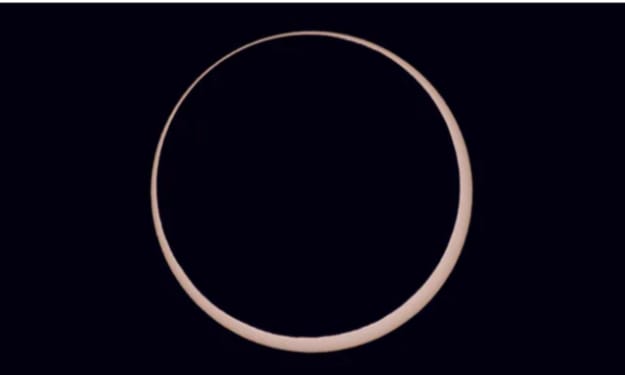
Annular Solar Eclipse Turns the Sun into a Dramatic 'Ring of Fire' Today! Here's What You Need to Know. AI-Generated.
Today, skywatchers around the world have a rare celestial spectacle to look forward to: an annular solar eclipse, a phenomenon that transforms the sun into a dazzling “ring of fire.” Unlike a total solar eclipse, where the moon completely covers the sun, an annular eclipse occurs when the moon is slightly farther from Earth in its orbit, leaving a brilliant ring of sunlight visible around the lunar silhouette. The event promises a breathtaking view for those in the path of annularity and an unforgettable glimpse of nature’s cosmic choreography for millions more.
By Sajida Sikandar9 days ago in Earth
Water Ceremony At The Mississippi River
We were especially pleased with the sun up in the sky today! And I talked about how much energy the sun gives me in the winter. I have never been diagnosed with seasonal affective disorder (SAD), but I believe I have it. My energy is like night and day when the sun hasn't been out for a few days.
By Denise E Lindquist10 days ago in Earth
The Day the Sky Turned Violet
It began quietly, almost imperceptibly. Early one morning, townspeople noticed the sky had taken on a strange shade—soft at first, a pale lavender that glimmered at sunrise. By midday, it deepened into a surreal violet, casting everything in unnatural light. Birds flew erratically, as if confused by the altered hue, and even the wind seemed hesitant, brushing through streets without its usual rhythm. People stepped outside, phones in hand, snapping pictures and sharing posts online. At first, scientists dismissed it as a rare atmospheric anomaly. But the unusual sky was only the beginning.
By Sudais Zakwan12 days ago in Earth
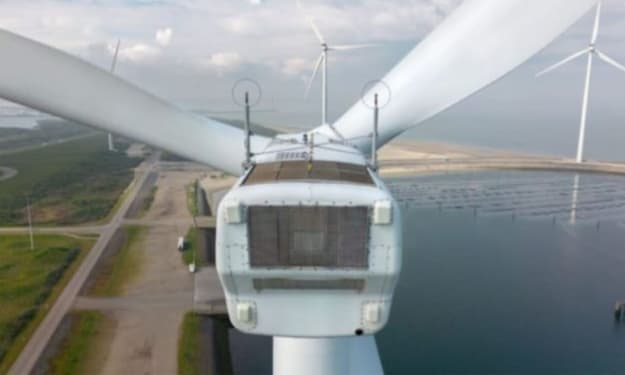
America Was Right About Wind Turbines: The “Dark Side” No One Wanted to Discuss, and Drones Begin to Move In. AI-Generated.
For decades, wind energy has been celebrated as a hero of renewable power—a symbol of a future free from fossil fuels. Towering wind turbines cutting through the sky are iconic images of progress and sustainability.
By Ayesha Lashari13 days ago in Earth
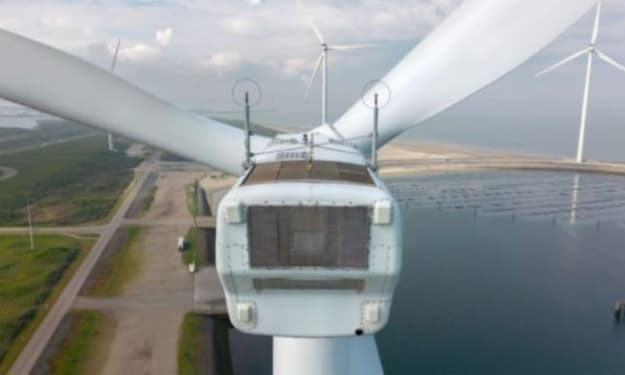
America Was Right About Wind Turbines: The “Dark Side” No One Wanted to Discuss, and Drones Begin to Move In. AI-Generated.
For decades, wind energy has been celebrated as a hero of renewable power—a symbol of a future free from fossil fuels. Towering wind turbines cutting through the sky are iconic images of progress and sustainability.
By Ayesha Lashari13 days ago in Earth
6 Minutes of Darkness: Get Ready for the Longest Eclipse of the Century That Will Turn Day Into Night. AI-Generated.
There are few moments in life when the world seems to pause entirely. The longest eclipse of the century promises to be one of those moments — six unforgettable minutes of darkness in the middle of the day, when the Moon will completely block the Sun and turn daylight into an eerie twilight. For skywatchers, scientists, and curious minds alike, this is more than just another astronomical event. It is a rare cosmic alignment that will remind us how small we are in the vast universe — and how extraordinary our view from Earth can be. What Is a Total Solar Eclipse? A total solar eclipse occurs when the Moon passes directly between the Earth and the Sun, casting its shadow onto Earth’s surface. For observers located within the narrow “path of totality,” the Moon completely covers the Sun’s bright disk. During those precious moments, daylight fades dramatically. The sky darkens. Stars may appear. The Sun’s glowing outer atmosphere — called the corona — becomes visible, forming a shimmering halo around the black silhouette of the Moon. Most total solar eclipses last only two to three minutes at any given location. However, this upcoming event is expected to last close to six minutes in some areas, making it one of the longest eclipse experiences of the 21st century. Why Will This Be the Longest Eclipse of the Century? The duration of a total solar eclipse depends on several astronomical factors aligning perfectly. First, the Moon must be relatively close to Earth in its elliptical orbit, making it appear slightly larger in our sky. At the same time, Earth must be slightly farther from the Sun, which makes the Sun appear marginally smaller. When these two conditions occur together, the Moon can cover the Sun more completely and for a longer period. Additionally, the eclipse path must cross regions near Earth’s equator, where the planet’s rotational speed is greatest. This subtle detail allows the Moon’s shadow to linger just a bit longer over certain locations. When all these cosmic variables align, the result is an extended totality — and in this case, nearly six full minutes of darkness that will turn day into night. What Happens During the Six Minutes of Darkness? As the eclipse approaches totality, the world begins to transform. Shadows sharpen and curve into crescent shapes. The light takes on a strange metallic tone. Temperatures can drop several degrees within minutes. Birds may fall silent or return to their nests. Some animals behave as though night has arrived unexpectedly. Seconds before totality, a dazzling flash known as the “diamond ring effect” appears — a final burst of sunlight peeking around the Moon’s edge. Then, suddenly, the Sun disappears. For six surreal minutes: The sky resembles deep twilight. Bright planets such as Venus or Jupiter may become visible. The Sun’s corona glows in delicate, silver-white strands. A 360-degree sunset effect circles the horizon. It is not complete darkness like midnight, but rather an otherworldly dimness that feels suspended in time. Then, just as abruptly as it began, a thin beam of sunlight reemerges. The diamond ring flashes again. Daylight returns, and life resumes its normal rhythm. Where Will Day Turn Into Night? Only those within the path of totality will experience the full six minutes of darkness. This path is typically narrow, stretching across select regions of continents and oceans. Outside the path, observers will see only a partial eclipse, where the Moon covers part of the Sun but never fully blocks it. While still impressive, a partial eclipse does not produce the dramatic transformation that totality delivers. For those eager to witness the longest eclipse of the century, early planning is essential. Major eclipses often draw travelers from around the globe, filling hotels and creating heavy traffic along the path of totality. For many, it is worth the journey. The Science Behind the Spectacle One of the most fascinating aspects of a total solar eclipse is the cosmic coincidence that makes it possible. The Sun is about 400 times larger than the Moon — but it is also roughly 400 times farther away from Earth. This proportional balance causes both objects to appear nearly the same size in our sky. Because of this rare alignment of size and distance, the Moon can perfectly cover the Sun’s bright surface, revealing the faint corona that is otherwise invisible. Scientists use long eclipses to study the Sun’s outer atmosphere, solar flares, and magnetic fields. Even in an age of advanced satellites and space telescopes, total solar eclipses still offer unique research opportunities. Beyond the science, however, lies the human experience — one that words often struggle to fully capture. A Shared Global Moment Throughout history, solar eclipses have inspired awe, fear, and wonder. Ancient civilizations often viewed them as omens or divine messages. Today, we understand the precise mechanics behind them, yet the emotional impact remains just as powerful. There is something profoundly humbling about watching the Sun — the source of all life on Earth — temporarily vanish. For six minutes, millions of people may look upward together. Strangers may cheer. Some may cry. Others may stand in silent reflection. In a world filled with constant motion and noise, a total solar eclipse forces us to pause. It reminds us that we are all part of the same cosmic dance. How to View the Eclipse Safely While totality is safe to view with the naked eye, every other stage of the eclipse requires proper eye protection. Looking directly at the Sun without certified eclipse glasses can cause permanent eye damage. To stay safe: Use ISO-certified eclipse glasses. Never rely on regular sunglasses. Ensure cameras, telescopes, and binoculars have approved solar filters. Remove glasses only during totality, and replace them immediately when sunlight returns. Preparation ensures that the experience remains both unforgettable and safe. Why You Shouldn’t Miss It The longest eclipse of the century is not just another date on the calendar. It is a once-in-a-generation opportunity to witness the universe in motion. Six minutes may not seem long in everyday life. But when the Sun disappears and the sky darkens in the middle of the afternoon, those six minutes stretch into something extraordinary. It is a reminder of the beauty of science. A demonstration of celestial precision. A shared human experience under one sky. When day turns into night, even briefly, the world feels different. And for six remarkable minutes of darkness, we will stand together beneath the Moon’s shadow — watching history unfold above us.
By Aqib Hussain14 days ago in Earth
China Has Planted So Many Trees Around the Taklamakan Desert That It’s Turned This ‘Biological Void’ Into a Carbon Sink. AI-Generated.
For generations, the Taklamakan Desert in northwestern China was considered one of the most lifeless places on Earth. Stretching across more than 330,000 square kilometers, this vast sea of sand earned the nickname “biological void” because almost nothing could survive its blistering heat, shifting dunes, and extreme lack of rainfall.
By Sajida Sikandar14 days ago in Earth
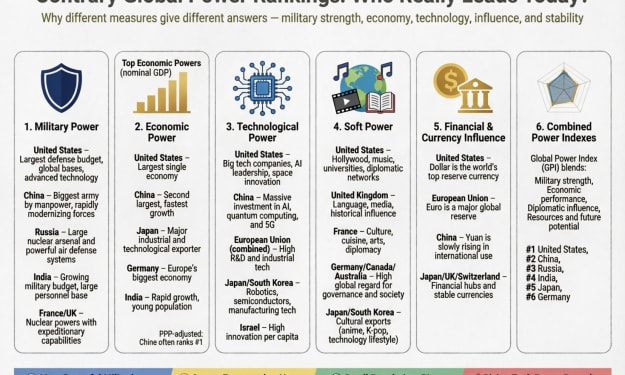
Contrary Global Power Rankings: Who Really Leads Today?
Contrary Global Power Rankings: Who Really Leads Today? When we talk about the “most powerful countries in the world,” many people immediately think of military strength or economic size. But real global power is complex and multidimensional. A country may have the largest economy, while another may have the strongest army, and yet another may wield outsized cultural influence. Different ranking systems lead to different leaders — and sometimes surprising results.
By Wings of Time 14 days ago in Earth
FCC Greenlights Massive Expansion of Amazon Leo Satellite Network. AI-Generated.
In a game-changing move for satellite broadband, the U.S. Federal Communications Commission (FCC) has approved Amazon’s plan to significantly expand its Amazon Leo low Earth orbit (LEO) satellite constellation. This approval allows Amazon to launch roughly 4,500 additional satellites, bringing the total network to nearly 7,736 spacecraft. It’s a bold step toward challenging SpaceX’s Starlink and pushing forward Amazon’s vision of global internet connectivity.
By Ayesha Lashari15 days ago in Earth