Horror
The Forest That Waits
She frowned at the ground around her. Surely there had been a trail just seconds ago; she had been following something to be this deep in the Forest. But now only sparse patches of dirt showed between thick tangles of weed and bracken, and she could neither find the path nor entirely remember if there had ever been one. A slow unease crept through her. She had come here for a reason. Hadn’t she? Everyone knew entering the Forest was a terrible idea. She was certain she had believed that once. Or had she? There had been a Before. She felt it faintly — lines carved into the ground, walls made of trees but not of trees, voices carried on wind instead of leaves. Something important hovered just out of reach. She gasped. “Ezra!” The name struck like lightning. She ran. Branches scraped her arms as she pushed forward, heart pounding, breath tearing from her chest. No need for a trail now. She remembered the child running — small footsteps disappearing into green shadow, laughter turning to silence. “Ezra!” The word burned in her throat. Not the first time she had shouted it. Her aching legs told her she had run for miles. Her drifting thoughts suggested she had been running longer than a day. The Forest did not answer. A clearing opened before her, sudden and perfect. She stumbled into it and fell to her knees, gasping. The air felt different here — too still, too calm. She sat where she had fallen, trying to gather fragments of memory. A town. A home. Raised voices. The child running. Running into the Forest. She squeezed her eyes shut. In stories, clearings brought answers. She wanted very badly to leave this one. When she opened her eyes again, the space felt almost rehearsed. The clearing was perfectly round. Sunlight fell in deliberate shafts through the canopy above, illuminating jewel-bright birds darting after insects. Wildflowers spread in careful arcs, drawing butterflies in flashes of impossible colour. Everything was beautiful. Everything was wrong. Sweat beaded on her skin despite the gentle breeze. Ezra was not there. But a narrow trail broke through the bushes at the far edge of the clearing. Hope surged through her — sharp and painful. She moved toward it. Then she saw the light. Off to one side, beyond the trees, a brightness shone — harsher than the clearing’s glow, like early morning breaking through fog. The edge of the Forest. Her breath caught. If she stepped toward it, she could leave. She felt it — freedom waiting just beyond the trees. Had Ezra already escaped? Was the child waiting there, safe? Or had Ezra gone deeper instead? The clearing held its silence. The same birdcall rang out — clear, identical, as if repeating a note long practiced. She hesitated. If she left now, she might never return. But if Ezra waited beyond the trees… She bit her lip, gazing toward the light. Then she turned back toward the trail. A few steps beyond the clearing she stopped again. Footprints marked the mud. She crouched. They overlapped each other — worn deep into the earth, not one path but many, layered together as if walked again and again. Her breath faltered. Slowly, she placed her foot into one of the prints. It fit perfectly. They were hers. And they were old. A cold understanding brushed against her mind — something vast and terrible and almost clear — but it slipped away before she could grasp it. The trail stretched ahead, waiting. She swallowed and stepped forward. The trees closed behind her with quiet patience. Moments later she paused again, uncertain. She frowned at the ground around her. Surely there had been a trail just seconds ago… Somewhere deeper in the Forest, the same birdcall echoed once more — unchanged, unhurried. And the Forest waited.
By Mina Carey10 days ago in Fiction
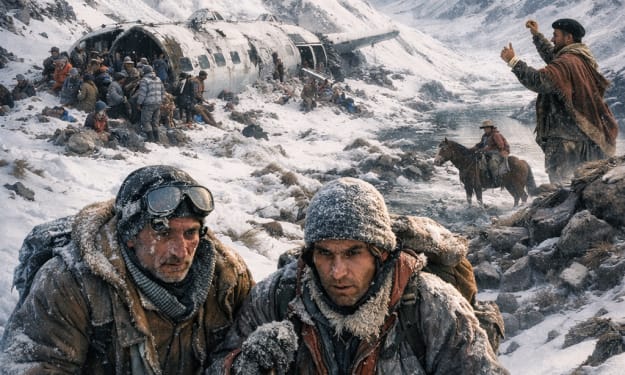
Miracle In The Andes Survivors
On October 13, 1972, a chartered plane carrying a Uruguayan rugby team known around the world as the Miracle in the Andes. The aircraft, operated by the Uruguayan Air Force, was transporting members of the Old Christians Club rugby team from Montevideo to Santiago. On board were 45 people, including players, friends, and family members. As the plane crossed the Andes, turbulent weather and navigational errors led the pilot to misjudge his position. Believing he had cleared the mountains, he began descending—directly into the snow-covered peaks.
By Ibrahim Shah 10 days ago in Fiction
Hey, Doll
"Hey Doll, open your eyes.” Barnaby’s house was not new to Marion, but it was still a nice gesture that he would carry her over the threshold. She could see it now, for the first time, as their home. He set her gently down on the floor and, locked in a tight embrace, they kissed. Before long they had moved to the bedroom to consummate the marriage.
By Amos Glade11 days ago in Fiction
The Weight of Things I Never Said
I used to believe silence was strength. When I was younger, I thought strong people were the ones who endured everything without complaining. The ones who swallowed their words before they could cause trouble. The ones who nodded instead of arguing. Who smiled instead of breaking. So I learned to be quiet. In our house, quiet was normal. It sat at the dinner table with us. It followed us into separate rooms. It slept between the walls. We spoke about practical things—bills, school, groceries—but never about feelings. Feelings were like fragile glass; no one wanted to be responsible for dropping them. My father believed in discipline more than conversation. My mother believed in endurance more than expression. I believed in survival. The first time I remember holding my words back, I was nine. I had drawn something at school—a messy picture of our family standing under a bright blue sky. I was proud of it. I ran home with the paper folded carefully in my bag. That evening, my father came home tired. The air felt heavy. I stood in front of him with the drawing in my hand. “Not now,” he said. He didn’t look at it. It wasn’t anger. It wasn’t cruelty. It was dismissal. Casual and unintentional. But something inside me folded along with that paper. I told myself it didn’t matter. But that was the first thing I didn’t say: I just wanted you to see me. As I grew older, silence became easier. When friends argued, I listened. When teachers were unfair, I accepted it. When someone hurt me, I told myself it wasn’t worth the trouble of explaining why. Every unspoken sentence settled somewhere inside me. Not loud enough to explode. Not light enough to disappear. In high school, I fell in love with someone who liked my calmness. “You’re so easy,” they said once. “You never overreact.” They meant it as a compliment. I smiled. What I didn’t say was that I overreacted all the time—just internally. My chest tightened. My thoughts spiraled. My heart rehearsed conversations I would never actually have. When they forgot my birthday, I said, “It’s okay.” When they canceled plans repeatedly, I said, “I understand.” When they slowly drifted away, I said nothing at all. The truth was simple: It hurt. But pain, when buried long enough, starts to feel like personality. I became the understanding one. The mature one. The strong one. People confided in me. They trusted me. They told me their fears and heartbreaks. I held their words carefully, like fragile glass. No one asked what I was holding. It wasn’t that they didn’t care. It was that I had trained them not to worry. I had built a version of myself that required nothing. Silence can be addictive. It keeps things stable. It avoids conflict. It makes you appear composed. But it also builds walls. The first crack in mine came unexpectedly. I was twenty-three when my mother and I argued for the first time in years. It started over something small—missed calls, unanswered messages. Ordinary things. But the frustration in her voice surprised me. “You never tell me anything,” she said. “I don’t know what you feel.” I almost laughed at the irony. For years, I had wanted to say the same thing to her. Instead, I stood there, heart pounding, old habits tightening around my throat. I could end this easily, I thought. I could apologize. I could retreat. I could stay silent. That would be safer. But something inside me was tired—tired of carrying words that had grown too heavy. “I learned from you,” I said quietly. The room changed. She looked at me differently, as if noticing a stranger standing where her child used to be. “What do you mean?” she asked. My hands were shaking. I wasn’t used to speaking without rehearsal. “I mean… we don’t talk about things. We just endure them. And I got good at that.” The confession felt fragile. Dangerous. For a moment, I thought she might deny it. Or dismiss it. Instead, she sat down. “I didn’t know you felt that way,” she said. Of course she didn’t. I had never told her. That conversation didn’t fix everything. We didn’t suddenly become expressive or emotionally fluent. Years of silence don’t disappear in a single evening. But something shifted. I realized that the weight I carried wasn’t entirely caused by others. Part of it belonged to me—the choice to stay quiet, again and again, even when my voice deserved space. Silence had protected me as a child. It kept peace. It avoided disappointment. But as an adult, it was isolating me. There’s a difference between being calm and being unheard. Between being patient and being invisible. Between choosing silence and being trapped inside it. I still struggle. Even now, there are moments when words rise to my lips and hesitate. Old habits don’t vanish overnight. Sometimes it feels easier to let things slide, to avoid the risk of misunderstanding. But I’m learning something new. Strength is not the absence of emotion. It is the courage to express it. The weight of things I never said still exists. Some words will probably remain buried forever. Childhood versions of myself still holding drawings no one saw. Younger versions swallowing tears no one noticed. I can’t go back and speak for them. But I can speak for who I am now. And every time I choose honesty over silence—even in small ways—the weight shifts. It doesn’t disappear. But it becomes lighter. Manageable. Because some words stay buried. But the ones we finally dare to say? They teach us how to breathe again.
By Inayat khan12 days ago in Fiction
The Whispering Woods. AI-Generated.
At the edge of Noman’s village stood a dense forest that locals simply called “The Whispering Woods.” No official maps marked it differently, yet everyone treated it with cautious respect. Hunters avoided going too deep. Children were warned not to wander near it after sunset. The trees stood unusually tall, their branches twisting together so tightly that sunlight barely touched the ground beneath. During the day, it looked mysterious. At night, it felt alive.
By Sudais Zakwan12 days ago in Fiction
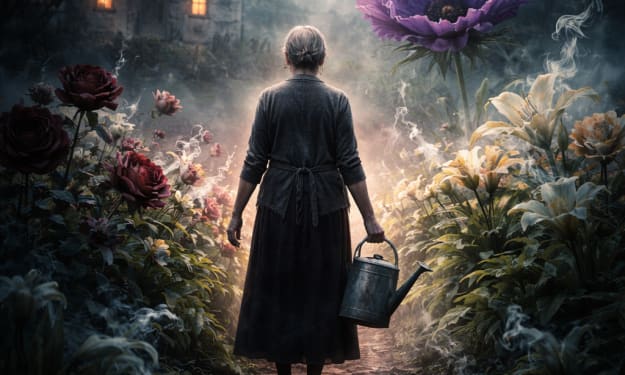
Mrs. Keene's Garden
Mrs. Keene’s garden bloomed brighter than any patch of earth had a right to in a place like this. Half of the town’s houses leaned on rotting stilts, paint stripped to pale boards. But behind her fence, neat rows of beautiful flowers stood tall and heavy-headed, their petals a strange mix of colours the neighbours whispered about. Crimson that bled to black. Yellow with streaks of green veins. White so pale it seemed to glow in the dusk.
By Steph Marie12 days ago in Fiction
The Proposal . Runner-Up in Rituals of Affection Challenge. Content Warning.
“There’s something I’ve been w-w-wanting to ask you for a v-very long time.” He drops to one knee and gazes up at her— the crack of half-smile on his lips and the threat of a tear in his eye.
By Sam Spinelli12 days ago in Fiction
The Fortunate Slice
The Thibodeaux family had not buried a child in three generations. Their land held when the river swelled. Their businesses endured downturns that closed others overnight. Illness came, but it did not linger. It was understood that blessings, like harvests, required tending.
By Christine Nelson12 days ago in Fiction