Humor
The Spot
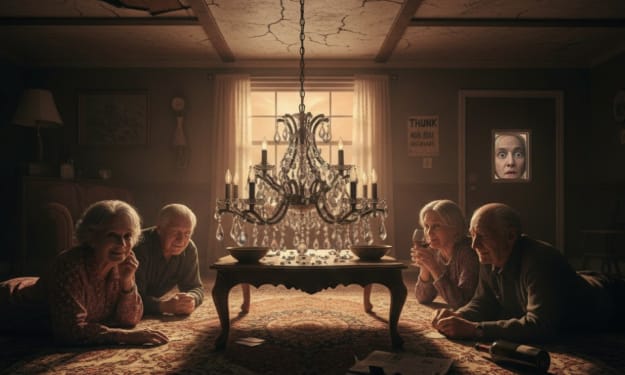
No one blinked. As they gathered by the image processor, taking time to adjust all of their eye sockets and each dial and module on the machine, they simply stared and stared at what they were looking at. No one thought to make a mental note of this; no one thought that their psychic connection could handle this. But there it was and they had to process it.
By Kendall Defoe a day ago in Fiction
History Voucher
Bonzai Dinewell zoomed into the living room with a bag full of goodies. He kicked off his electric boots and collapsed onto the sofa beside his android dog, Fletch, who had been upcycled from old watering cans. His partner of many years, Comet, glanced up from his tablet and eyed the records sticking out of the bag.
By Chloe Gilholy6 days ago in Fiction
There's A Hole in My Bucket. Top Story - February 2026.
It’s a well-known fact that Liza Dufresne was always the brains in the family. She was the one who always came up with the brilliant schemes the Dufresne kids carried out when they were younger. Like when they tricked Mrs. Claybourn into paying for a trip to Disney World. Liza convinced her that their parents had been kidnapped and were being held for ransom for the total price of three tickets. In reality, they were away on a weekend getaway for their anniversary. When they returned, Liza told the Claybourns that they did not like to talk about the ordeal. Their parents never found out how they got the money. Mrs. Claybourn never found out that the Dufresne parents were never really in any danger.
By David E. Perry7 days ago in Fiction
A normal day in small town England
A normal day in small town England Nothing worth mentioning. It was a dark and stormy night, well actually, a chilly wet November day but the concept is the same. I parked the car in the high street, main street for any Americans who read this, and wandered over to the door of a well decorated coffee shop. The door opened as I got near and two very well-dressed middle-aged ladies emerged. They ignored me and hurriedly crossed the road to a waiting car. I entered and found a vacant table, ordered a double shot of unsweetened plain Expresso, which turned up surprisingly fast. I sat back in the chrome and black vinyl chair and took a look round at my fellow customers. All appeared to be well off financially, well dressed, well fed and professionally groomed, it wasn’t much of a guess that ladies hair salons did well in this town. No leather jacketed unshaven bikers or guys in working clothes were in this café. Even the obviously younger members of the clientele were well behaved and were smartly dressed, as if in a 1950’s TV commercial. There was no background music, conversations were subdued and what laughter I heard was polite rather than raucous. I finished my coffee paid the waitress and left. I crossed the road and walked into a clothing store, the serving staff greeted me and politely asked if I wanted anything specific, when I said I was just browsing they retreated behind their serving desks and left me to my stroll around the shop. I saw nothing that appealed and so found my way out and wandered the street window shopping, until I saw a jewellers with an eye-catching window display of dazzling diamonds. My opening the door operated a musical alert to the staff, but they did not appear to notice. I looked at a display of necklaces some very expensive and all very well designed. Even to my untutored eye they looked elegant and well made. Even the lowest ticket price was too high for my bank balance, but they were nice enough to look at. I wandered further down the street and found a book shop. Again, the staff were all politeness and careful deference, I found the historical fiction section and spent a very pleasant half hour sample reading some of the newest offerings. The staff were very attentive providing an apparently endless supply of coffee and friendly advice on the latest popular authors. On leaving the book shop I crossed the street to the municipal museum and art gallery. There was no charge for entry, and the place was warm and comfortable, a small group of children, escorted by their teacher, were studying a display of water colours all painted by the same local artist. The artist’s name was unknown to me, but they were technically well done but lacking that hard to define “something” that separates a technician with a pencil and brush, from a truly compelling artist. The children were all so very well behaved, studiously taking notes as the teacher spoke. Not one gave me more than a glance, their attention focused on the teacher and the paintings. I wandered up the wide staircase and entered the rooms housing the towns official archives. There were 3 rooms all spotlessly clean, interconnected and painted in soothing pastel colours. They depicted the towns growth from a tiny hamlet, created by housing for farm workers, to the busy market town and then onto the present residential dormitory town where most people worked in the city 20 miles away. All through my study of the town’s history, the unobtrusive security staff kept a discreet watch to ensure nothing was removed from the displays. Since I was naked, I had to wonder where they thought I could hide any document if I stole one.
By Peter Rose8 days ago in Fiction
The Empty Chair
I sit in my living room and look upon the empty chair. Once, a human being sat there, with life and love within him. A person with dreams, goals, and the ambition to achieve them all. Now there is only air. Empty air, dusty air, illuminated by the scant sunlight that drifts in through the dirty window.
By Ophelia Keane Braeden9 days ago in Fiction
The Pest Control Problem
The Pest Control Problem The infestation had reached Phase Three before the council agreed to call it that. Before then, it had been “a nuisance,” then “an ecological irregularity,” and briefly — during the optimism of early containment — “an opportunity for adaptive learning.” Now it was simply a problem. “They multiply too quickly,” said Mara, circling slowly at the center of the gathering. “We remove one cluster and another appears within a season.” “They’ve always been present,” replied Torin. “Perhaps we are only now noticing them.” “They weren’t climbing onto structures before,” someone added from the outer ring. “Or dragging debris with them. The noise alone is disruptive.” A low chorus of agreement moved through the assembly, vibrations rippling through the water between them. The thing was, settlement had never needed formal pest control guidelines. Predators and scavengers existed, of course, but they belonged to familiar cycles. Even invasive species usually followed predictable patterns. These creatures did not. They gathered in clusters of hard-edged shells that cut through the water unnaturally. They moved in chaotic bursts, then stopped entirely, floating in place as if unsure what to do next. “I propose targeted removal,” said Edda, who had always favored decisive solutions. “They show aggression when approached. Several of our young have been startled by their machines.” “They are curious,” countered Sol, whose research group had documented the creatures for months. “Curiosity is not aggression.” “They throw objects,” someone muttered. “That is also curiosity.” “Or poor coordination,” added another voice. A ripple of dry amusement passed through the group. The first recorded incident had occurred near the southern migration route. A cluster of the pests had arrived inside a white shell structure, drifting without purpose. They produced constant noise — tapping, scraping, irregular bursts of vibration. Torin’s pod had watched from a distance. “They seemed excited,” Torin had said later. “At nothing in particular.” “Perhaps they are easily pleased,” Mara replied. “They attempted to communicate.” This had caused considerable discussion. “What did they say?” Torin paused. “It is difficult to translate. They produced a series of high-frequency sounds. Repetitive. Without structure.” The group made uneasy movements, and Torin was hasty to add, “but they seemed aware that sounds had meaning. They show significant evidence of being self aware, actually.” This caused a few sideways glaces, and Torin knew they were thinking the same thing he was: was that a good thing? Not all interactions had been negative. There were documented cases of the pests offering objects, such as fish, seaweed, and occasionally, very sharp sticks. The orcas who felt more neutral towards the pests began studying them in earnest. “They present food,” Sol insisted during one meeting, delighted by the implications. “It may be an attempt at mutualism.” “They’re trying to tame us,” Edda said flatly. The idea had been met with laughter, drowning out the few and feeble voices of the elder whales, who still spoke of friends and family that had vanished from the ocean; snatched by a monstrous being made of rough tendrils forming a stout web. Any who did hear their claims were quick to roll their eyes. Still, the behavior continued. Several young adults reported being approached by individual pests who held out offerings while emitting excited bursts of sound. “They appear pleased when we accept,” Sol noted, “And confused when we don’t.” The escalation began with the vessels. The pests relied heavily on their shells. Without them, they struggled to move effectively. Some members of the community discovered that nudging the vessels disrupted their movement. Others learned that more forceful contact stopped them entirely. The first incident had been accidental… The second less so. “They learn quickly,” Mara observed. “Yes,” Edda agreed. “So must we.” Debate intensified. Group One advocated complete removal. “They damage the environment. They pollute. They disrupt migration routes.” Group Two favored conditional intervention. “Only when they cause harm. Otherwise we observe.” Group Three found the pests fascinating. “They construct tools,” Sol argued. “They attempt communication. They bring gifts. This may represent a rare opportunity.” “You want to continue to study them,” Edda said. “Yes.” “You always want to study everything.” “That is because everything is interesting.” Edda sighed, but had no retort. The council reviewed recordings. One showed a pest attempting to climb onto a drifting structure, slipping repeatedly but persisting with admirable determination. Another depicted a cluster celebrating loudly after catching a fish — though their technique appeared inefficient. A third recording caused particular discomfort. A young calf had approached a vessel out of curiosity. The pests had reacted with frantic motion, pointing and shouting. “They appear frightened of us,” Sol said, puzzled. “As they should be,” Edda growled. Reports continued. Some pests damaged one another’s structures without obvious cause. Others drifted aimlessly for long periods. They generated waste that accumulated in the water. “They do not understand consequences,” Mara concluded. “Or perhaps they do,” Sol said quietly. “And proceed anyway.” The council convened again as the sun filtered through the upper layers, breaking into long shifting beams. “We require guidelines,” Mara said. “Not ideology.” Agreement followed. Draft proposals circulated: 1. Observe when possible. 2. Intervene only when harmful behavior escalates. 3. Encourage distance between settlements and pest activity zones. 4. Allow controlled interaction for research purposes. 5. Avoid unnecessary aggression. “And what,” asked Edda, “counts as unnecessary?” No one answered. The next escalation arrived without warning. Several pests had gathered in a large shell structure, emitting violent noise and expelling waste into the water. Edda’s group approached. They nudged the vessel. It did not stop. They struck harder. The vessel fractured. The pests fled into the open water, limbs flailing. “They seemed shocked,” Sol reported later. “Perhaps they believed themselves invulnerable.” said Edda. Her quiet satisfaction was obvious. With a sigh, Torin turned from his companions to join the gathering crowd. This had to be discussed. Reactions within the settlement were mixed; some celebrated the success, while others worried about escalation. Sol remained fascinated. “They adapt,” Sol said. “After the incident, their vessels began avoiding certain areas. They remember.” “Memory implies learning,” Mara said. “Yes.” “And learning implies risk.” “…Yes.” More recordings arrived. A pest carefully placing a fish before backing away. Another reaching out tentatively toward a passing juvenile. A cluster observing silently from a floating structure, their attention fixed. “They are studying us,” Sol said, almost reverently. “Then they should study better,” Edda replied with a snort. Gradually, a consensus formed. The pests were neither purely destructive nor harmless. They were… complicated, as any living being can be. The final vote occurred during migration season. The council assembled beneath shifting light, currents carrying distant echoes through the water. “All in favor of adopting the guidelines?” The motion passed easily. The settlement dispersed, each member returning to their paths. Above them, near the surface, several pests clung to a drifting shell, pointing downward. They emitted excited bursts of sound as the pod moved beneath them. One dropped a fish. It spiraled slowly toward the depths. Sol accepted it, amused. “They are persistent,” Sol said. “They are pests,” Edda replied. “They are trying,” Sol countered. They rose together toward the light, breaking briefly through the surface before diving again, vast bodies moving with effortless precision. Behind them, the small creatures continued to shout and wave from their fragile vessels, convinced they were witnessing something extraordinary. Below, the council’s new guidelines spread through the pods. Above, humanity debated its latest sightings of unusual whale behavior. And far beneath the surface, the orcas adjusted — patient, curious, and increasingly certain that the infestation would require ongoing management.
By Mina Carey9 days ago in Fiction