Science
Science
How Predictive Maintenance Is Changing Aircraft Parts Demand. AI-Generated.
The aviation industry is rapidly evolving as predictive maintenance reshapes how airlines and maintenance providers manage aircraft performance. Instead of relying solely on scheduled inspections or reacting to unexpected failures, modern aviation operations now use real-time data and advanced analytics to anticipate maintenance needs. This transformation is significantly changing aircraft parts demand, influencing procurement planning, inventory control, and supplier relationships across the global aerospace supply chain.
By Beckett Dowhan11 days ago in FYI
Reality Was Supposed to Make Sense. Science Disagreed.
We tend to assume reality is stable because that assumption is useful. Time moves forward. Solid things stay solid. Cause politely precedes effect. It’s a comforting arrangement. Science has spent the last century suggesting that reality never signed that agreement. The deeper we look, the less the universe resembles a well-behaved machine and the more it feels like a system that tolerates our expectations only until we examine them closely. Every major discovery seems to follow the same pattern: something we thought was fundamental turns out to be… negotiable. Which raises an uncomfortable possibility. Maybe reality didn’t become strange. Maybe we just started paying attention. Time Isn’t Universal — Which Feels Slightly Unfair Time feels obvious. Clocks tick. Events happen. Everyone agrees on when lunch is. At least locally. Relativity introduced an idea that still feels mildly rude: time passes differently depending on motion and gravity. Two observers can measure different durations between the same events, and physics refuses to choose sides. Astronauts returning from orbit have technically aged a little less than people on Earth. GPS satellites must constantly correct for time dilation or navigation systems would drift into chaos. So time isn’t a shared universal river. It’s more like a personal experience stitched to movement through space. Which means somewhere, right now, two perfectly accurate clocks are disagreeing — and neither is wrong. Solid Matter Is Mostly Empty Space Pretending Otherwise If you knock on a table, it feels confidently real. The kind of solid you don’t question. Physics quietly suggests you probably should. Atoms are mostly empty space. What you experience as solidity is the electromagnetic repulsion between particles preventing them from occupying the same position. You’re not touching the table in the way intuition suggests; you’re encountering a boundary enforced by invisible forces. Matter behaves less like a brick wall and more like a negotiation between fields. The universe runs on agreements between things that never actually meet. Which is deeply inconvenient if you prefer reality to feel straightforward. Quantum Particles Refuse to Commit Until Asked Classical physics taught us that objects have definite properties whether or not we observe them. Quantum mechanics looked at that assumption and declined to participate. At small scales, particles behave as overlapping probabilities rather than fixed objects. They exist in multiple possible states until measurement forces a specific outcome. Before interaction, reality seems undecided. Scientists still debate what this means philosophically, but experiments keep confirming the behavior. Which leaves us with an unsettling thought: the universe might not be a finished structure waiting to be understood. It might be an ongoing process that becomes definite only when something engages with it. Empty Space Is Busy Being Empty “Nothing” sounds simple. Physics has other plans. Even a vacuum contains fluctuating quantum fields where particles appear and disappear constantly. These tiny events influence measurable forces and shape how matter behaves. Silence, it turns out, is noisy. Nothingness isn’t absence. It’s activity we rarely notice. Your Brain Edits Reality Before You See It We like to believe perception is passive — eyes open, information enters, reality arrives. Neuroscience suggests something closer to improvisation. Your brain predicts incoming data, fills gaps, filters noise, and constructs a usable version of the world before you become aware of it. You’re not seeing raw reality; you’re seeing a model optimized for survival. Accuracy was never the main goal. Efficiency was. Which explains why reality feels coherent even when it isn’t entirely accurate. The Universe Might End Quietly Popular imagination prefers dramatic endings. Cosmic explosions. Spectacular finales. Current cosmological models suggest something less theatrical: continued expansion, gradual cooling, stars fading one by one until energy spreads thin across an increasingly quiet universe. No grand climax. Just a slow dimming. Even the end of everything might refuse to perform for us. So What Actually Changed? None of these discoveries made reality stranger. They revealed that our assumptions were overly confident. Time isn’t universal. Matter isn’t solid. Observation isn’t passive. Nothing isn’t empty. Perception isn’t objective. The universe doesn’t exist to feel intuitive. It exists to follow rules that occasionally look like practical jokes from our perspective. And every time we think we’ve reached the final explanation, reality expands just enough to remind us that certainty is temporary. We didn’t lose simplicity because science complicated the universe. We lost it because we started looking closer — and reality became a little more unreal.
By Mina Carey12 days ago in FYI
New Gambling Culture Effecting our Youth
In the span of a single decade, gambling has shifted from smoky back rooms and neon-lit casinos to something far more subtle and far more dangerous: the smartphone. What once required travel, cash, and age verification at a physical location now fits neatly inside a device that most teenagers carry in their pockets every day.
By AnthonyBTV12 days ago in FYI
Deforestation in the Amazon reduces the rain forest's capacity to produce its own precipitation.
A recent research demonstrates what many scientists have long assumed but can now detect with precision from space: the local climate changes when big swaths of the Amazon are cleared.
By Francis Dami12 days ago in FYI
How Tight Tolerances Improve Aircraft Mechanical Systems. AI-Generated.
In aerospace engineering, precision is measured in microns. Tight tolerances refer to the extremely small allowable variations in a component’s dimensions during manufacturing. Unlike general industrial production, where slight deviations may be acceptable, aircraft mechanical systems demand exact conformity to design specifications.
By Beckett Dowhan12 days ago in FYI
10 Largest Things in Nature That Will Make You Feel Incredibly Small
Astronauts who return from space often talk about the “overview effect,” that overwhelming realization that Earth, and all of us on it, are just microscopic specks in the vast universe. But here’s the thing: we don’t even have to leave our planet to feel that humbling perspective.
By Areeba Umair13 days ago in FYI
Dense Fog Advisory: When the Road Disappears
There is something unsettling about driving into a wall of white. One moment the road is clear. The next, it fades into a blur. Streetlights glow like distant stars. Headlights reflect back into your eyes. Your hands tighten on the steering wheel without you even realizing it.
By Muqadas khan13 days ago in FYI
How Advanced Machining Supports Aircraft Reliability . AI-Generated.
Aircraft reliability begins long before takeoff. It starts in the manufacturing facility, where raw materials are transformed into highly engineered components. In aerospace production, advanced machining plays a central role in ensuring that every part meets strict dimensional and structural requirements.
By Beckett Dowhan13 days ago in FYI
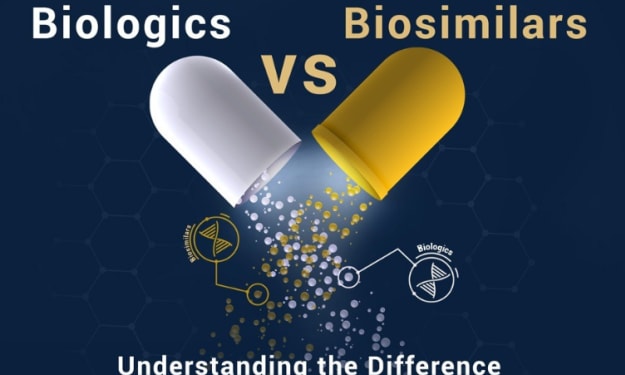
South Korea Biosimilar Industry Growth is to USD 3,513.2 Million By 2033 | CAGR 24.05%. AI-Generated.
South Korea Biosimilar Industry Overview Biosimilars are biologic medical products that are highly similar to already approved reference biologic drugs, offering comparable safety, efficacy, and quality at a reduced cost. In South Korea, the biosimilar industry has gained strong momentum due to robust research infrastructure, regulatory support, and strategic export orientation.
By Ashutosh Srivastava13 days ago in FYI