
Three Pakistani Women Explore Egypt in Wheelchairs, Challenging Stereotypes
Determined to prove that disability does not define limits, three friends travel across Egypt to show the world that women with disabilities can live independently and boldly.

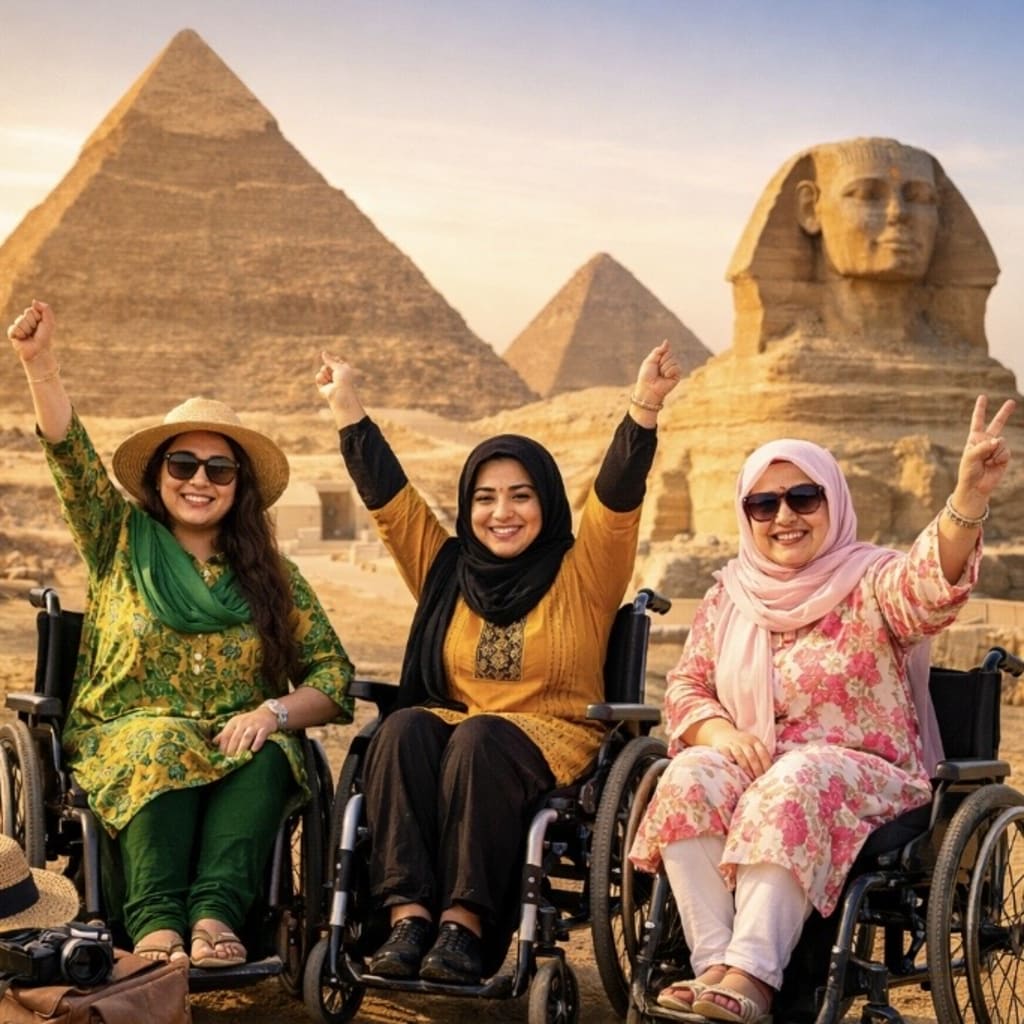
Traveling across a foreign country can be challenging for anyone, but for three Pakistani women who use wheelchairs, it became a powerful statement of courage, independence, and resilience. Their journey to Egypt was not just a vacation—it was a mission to challenge social perceptions and inspire others living with disabilities.
The three friends, all wheelchair users, decided to travel together to explore Egypt’s ancient wonders. From the towering pyramids to the bustling streets of Cairo, they set out to experience the country’s culture, history, and landscapes while demonstrating that physical limitations do not prevent people from living full and adventurous lives.
For many people with disabilities, especially in developing countries, traveling can seem nearly impossible due to social attitudes, limited accessibility, and logistical challenges. The three women were aware of these barriers, but they refused to let them stop them.
“We wanted to show the world that a disabled girl is not dependent on anyone,” one of the travelers said. “If we are given opportunities and accessibility, we can do everything that others can.”
Their journey took them to some of Egypt’s most famous historical sites, including the iconic Great Pyramid of Giza and the vast plateau where the legendary Great Sphinx of Giza stands. Visiting these ancient landmarks was not easy, as many historic sites were not designed with accessibility in mind.
However, the women approached every challenge with determination and creativity. In some places, they relied on the support of locals who helped them navigate uneven paths and steep entrances. In other situations, they carefully planned routes and schedules to ensure they could safely explore the sites.
The travelers documented their experiences through videos and social media posts, sharing the realities of accessible travel. Their content quickly attracted attention, with many viewers praising their bravery and positive attitude.
For them, the purpose of the trip was not only personal enjoyment but also advocacy. They wanted to highlight the importance of accessibility in tourism and public infrastructure.
“Travel should be possible for everyone,” one of them explained. “When cities become accessible, they don’t just help disabled people—they help elderly people, parents with strollers, and many others.”
In Pakistan, people with disabilities often face social stigma and limited opportunities. Families sometimes become overprotective, fearing that the outside world is too difficult or dangerous. The three women believe such attitudes can unintentionally limit independence.
By traveling abroad on their own terms, they hoped to change this narrative.
Their journey also demonstrated the power of friendship and mutual support. Traveling together allowed them to help one another with everyday tasks, share responsibilities, and maintain confidence in challenging situations.
Beyond the famous landmarks, the women also explored the vibrant culture of Cairo. They tasted traditional Egyptian dishes, visited local markets, and interacted with residents who were often curious and supportive of their journey.
Many locals expressed admiration for their determination. Some even stopped to take photos with them or offer assistance, turning simple encounters into memorable cultural exchanges.
For the travelers, these moments of kindness reinforced their belief that the world can become more inclusive when people show empathy and understanding.
Their story has resonated with many people online, particularly young women with disabilities who rarely see such examples of independence in mainstream media. Messages of support poured in from across Pakistan and beyond, with many viewers saying the trip gave them hope and motivation.
The women now hope their journey will encourage others with disabilities to pursue their dreams, whether that means traveling, studying, working, or starting their own projects.
They also hope governments and tourism industries will invest more in accessible infrastructure. Simple improvements—such as ramps, elevators, and accessible transportation—can make a huge difference for millions of people worldwide.
As their Egyptian adventure came to an end, the three friends reflected on what the journey meant to them. It was more than sightseeing; it was a statement about independence and possibility.
Their message was clear: disability does not mean inability.
By traveling across Egypt in wheelchairs, these three Pakistani women proved that determination, courage, and friendship can overcome many barriers—and that the desire to explore the world belongs to everyone.
About the Creator
Irshad Abbasi
Ali ibn Abi Talib (RA) said 📚
“Knowledge is better than wealth, because knowledge protects you, while you have to protect wealth.
Keep reading
More stories from Irshad Abbasi and writers in History and other communities.
A 4,400-Year-Old Priestess Tomb Discovered in Egypt
Archaeologists in Egypt have uncovered the remarkable tomb of a priestess that dates back approximately 4,400 years, offering new insight into religion, culture, and daily life during the height of the ancient Egyptian civilization. The discovery was made near the famous pyramids on the Giza Plateau, one of the most important archaeological areas in the world. Experts believe the tomb belonged to a high-ranking priestess named Hetpet, who lived during Egypt’s Fifth Dynasty, around 2400 BC. 
By Irshad Abbasi a day ago in History




Comments
There are no comments for this story
Be the first to respond and start the conversation.