
Russian ‘Shadow Fleet’ LNG Tankers Reroute After Blast Sinks ‘Arctic Metagaz’ in Mediterranean
A sanctioned Russian LNG tanker sinks in the Mediterranean amid contested attacks, prompting rerouted routes and disruptions for Moscow’s limited export fleet.

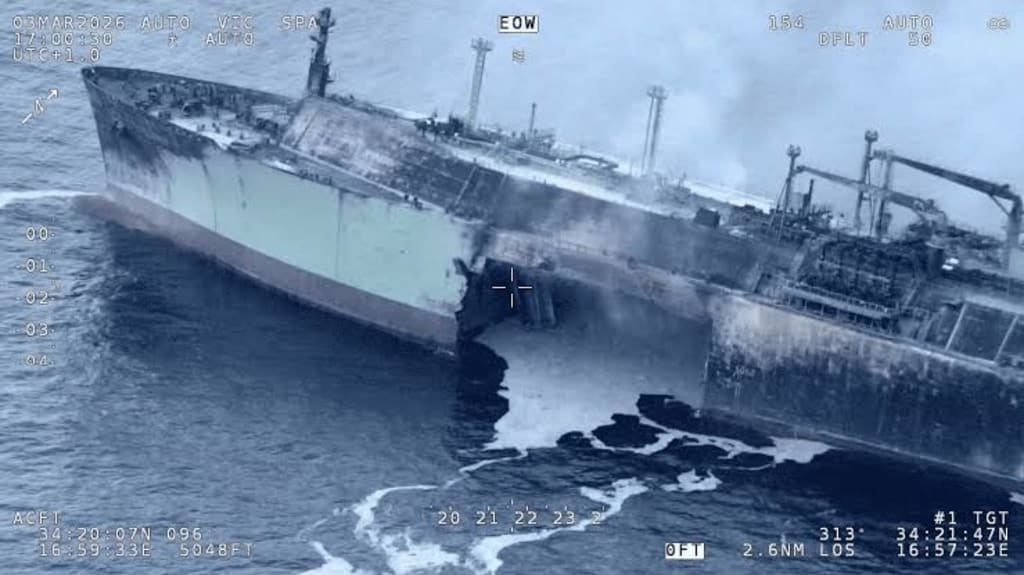
One of Russia’s sanctioned liquefied natural gas (LNG) carriers has sunk in the Mediterranean Sea, prompting remaining vessels tied to the Kremlin’s so‑called “shadow fleet” to halt, delay, or change routing as fears grow about the safety of key shipping corridors. The incident — which Moscow says was caused by a Ukrainian naval drone attack — highlights escalating risks to maritime energy transport as Russia’s energy exports face mounting pressure from conflict and sanctions.
The Arctic Metagaz, an LNG tanker linked to Russia’s Arctic LNG 2 export project, was destroyed off the coast of Libya — roughly 150 nautical miles north of Malta — after experiencing powerful explosions and catching fire in early March. Italian and Libyan maritime authorities confirmed the vessel sank following a major blaze that engulfed it late on March 3, though all 30 crew members were safely evacuated by rescue teams.
Russia Blames Ukrainian Drones
In statements released after the sinking, the Russian Ministry of Transport accused Ukraine of directing a drone attack from the Libyan coast using naval unmanned boats, marking what Moscow described as an act of “international terrorism and maritime piracy.” Ukrainian officials have not publicly commented on the accusation.
While state media narratives frame the incident as a deliberate strike on Russian energy infrastructure, independent verification of the attack’s cause remains limited. Some analysts note that Moscow’s sanctioned vessels, often operating outside Western restrictions, have become symbolic targets because of their role in bypassing sanctions aimed at cutting Russia’s energy revenue.
A Blow to Russia’s Shadow Fleet Logistics
The sinking of Arctic Metagaz has had an immediate impact on the operations of Russia’s “shadow fleet” — a collection of older tankers that transport hydrocarbons for sanctioned energy projects, such as Arctic LNG 2, around the world. The fleet has already been constrained by Western sanctions that limit access to insurance, financing, and port services, leaving only a small number of vessels able to carry cargo.
Tracking data shows that several other Russian LNG carriers altered their movements in response to the blast. The Arctic Pioneer, which was transiting north through the Suez Canal at the time of the explosion, appears to have held offshore near Port Said for over 48 hours. Meanwhile, the Arctic Vostok, originally sailing westward across the eastern Indian Ocean, changed course and began heading south, possibly preparing to circumvent the Suez Canal by way of the Cape of Good Hope at Africa’s southern tip.
Such deviations represent a rare and costly departure from established Arctic LNG‑to‑Asia routes. Circumnavigating Africa adds thousands of nautical miles — and weeks — to voyages, significantly increasing fuel costs, crew time, and delivery schedules. For a fleet already stretched thin, these disruptions could weaken Russia’s ability to sustain consistent LNG exports.
Broader Energy Market Ripples
The Arctic LNG 2 project was already running at a fraction of its full capacity due to logistical limitations and sanctions. This latest incident underscores how fragile those supply chains have become and how geopolitics can impact global energy flows far from conflict zones. Analysts warn that if other vessels begin to avoid the Mediterranean entirely, the additional transit time will reduce the number of voyages each tanker can complete in a year, tightening shipments to buyers — especially in East Asia — and potentially driving up LNG prices.
Some industry observers say that Russia may have to rely increasingly on direct Arctic routes in summer months or seek alternative buyers closer to its production hubs. However, these options remain limited given fleet size and sanctions constraints.
Risks to Shipping and Regional Security
The incident also highlights the increasing vulnerability of energy tankers in contested waters. As global geopolitical tensions intersect — from the Ukraine war to Middle Eastern instability — commercial vessels are frequently caught between military actions and international sanctions regimes. Cruise ships, cargo carriers, and LNG tankers alike face heightened risk of unexpected attacks or collateral damage when navigating strategic chokepoints such as the Mediterranean and Suez transit route.
Environmental concerns also linger following the sinking. Although LNG tankers carry less oil than typical crude carriers, authorities in the region continue to monitor the site for potential gas release or secondary impacts on marine ecosystems. Meanwhile, shipping insurers and charterers are reassessing risk models for vessels traveling near conflict zones.
Looking Ahead
For Moscow, the loss of Arctic Metagaz complicates an already strained export strategy and could prompt broader changes in how Russia moves LNG to global markets. Whether remaining tankers will continue to transit high‑risk corridors or adopt longer, safer routes around Africa remains an open question. The decision will hinge on geopolitical developments, insurance availability, and how both Russian and Western authorities respond to this high‑profile maritime incident.
About the Creator
Fiaz Ahmed
I am Fiaz Ahmed. I am a passionate writer. I love covering trending topics and breaking news. With a sharp eye for what’s happening around the world, and crafts timely and engaging stories that keep readers informed and updated.
Keep reading
More stories from Fiaz Ahmed and writers in Journal and other communities.
LNG Shipping Rates Soar 650% to $300,000 Per Day
Global liquefied natural gas (LNG) shipping rates have spiked dramatically in recent weeks, with some charter rates climbing as much as 650 percent to about $300,000 per day — a surge driven by widespread supply disruptions tied to geopolitical tensions in the Middle East and pressure on global energy markets. The increase has sent shockwaves through commodity markets, shipping firms, and LNG buyers, highlighting how sensitive energy logistics are to political instability and supply chain risk. Why Rates Are Skyrocketing The main catalyst for the surge in LNG charter rates is the disruption of traditional shipping routes, particularly those passing through the Strait of Hormuz. This narrow waterway, which sits between Iran and Oman, is a major artery for crude oil and LNG tankers. Recent military escalations and attacks on vessels in the Gulf have pushed shippers to re‑route around longer and less predictable pathways, increasing voyage times, fuel costs, and operational complexity for tanker fleets. Under normal circumstances, LNG ships traveling from the Middle East to major consuming regions such as East Asia and Europe would use the most direct route through Hormuz, keeping transit times and costs down. But with regional airspace restrictions, military activity, and heightened risk of missile or drone incidents against commercial vessels, many operators are opting for alternative passages — such as sailing around Africa’s Cape of Good Hope — adding thousands of nautical miles to each journey. Longer routes mean more time at sea, higher bunker fuel bills, and fewer voyages per year for each vessel. As a result, demand for available LNG carriers has outstripped supply, pushing daily charter rates upward. According to shipping brokers, some modern large‑class LNG carriers that typically earn $40,000–$50,000 per day before the crisis are now commanding up to $300,000 per day on the spot market — a roughly 650 percent increase. Market Impact Beyond Shipping The surge in shipping costs is affecting more than just vessel operators. LNG buyers are feeling the impact in contract pricing and delivery strategies, and refiners and utilities in Europe and Asia are wrestling with tighter supply and rising costs. Because LNG is sold on both long‑term contracts and short‑term spot markets, volatile freight costs can quickly get passed through to consumers or squeeze the margins of energy companies. In recent weeks, some LNG cargoes have been rerouted, delayed, or canceled as buyers reassess the total cost of delivered fuel. For countries like Japan and South Korea, which depend heavily on LNG for power generation, the combination of higher freight rates and constrained supply options has raised concerns ahead of peak seasonal demand periods. European consumers, already contending with higher energy prices due to regional instability, may also face elevated utility bills if LNG cargoes become more expensive to deliver. Why the Current Situation Is Worse Than Normal Several factors have converged to make the current surge in LNG shipping rates sharper than past disruptions: 1. Limited Spare Shipping Capacity: Before the crisis, the global LNG fleet was already operating near peak utilization due to recovery in demand after the pandemic. Fewer idle vessels mean less flexibility in redeploying ships to new routes. 2. Longer Routes Increase Demand: As carriers avoid high‑risk areas, each round trip takes more time and ties up each vessel for longer, reducing overall fleet efficiency. 3. Insurance Costs Rising: Insurers have added premiums and exclusions for vessels transiting high‑risk zones, making some shipowners reluctant to risk sailings without higher compensation. This further reduces available capacity and drives brokers to raise freight rates to attract willing operators. 4. Energy Market Volatility: Elevated crude and LNG prices have increased the overall cost of energy logistics, leading charterers to commit to higher freight rates rather than risk missing critical deliveries. Responses from Industry Players Shipping companies and charter brokers say the spike is temporary but caution that volatility could persist if geopolitical tensions continue. Several major shippers have announced measures to mitigate risk, including: Rebalancing Ship Deployment: Reallocating vessels from other regions to cover high‑demand LNG routes. Multi‑Year Contracts: Locking in long‑term charters at elevated rate floors to secure capacity. Rerating Risk Models: Re‑evaluating risk assessments to incorporate persistent geopolitical uncertainty. Some LNG buyers are exploring portfolio diversification, seeking alternative suppliers that can deliver from less volatile regions. Others are working with national governments to negotiate strategic deliveries and secure access to existing contracts. Broader Economic Implications The LNG freight surge illustrates how geopolitical instability can ripple through the interconnected global energy system. High shipping costs may accelerate energy price inflation, add pressure to already tense global supply chains, and force buyers to rethink their consumption and contract strategies. Emerging economies and developing countries that rely on LNG imports could be particularly vulnerable to higher delivered energy costs. Meanwhile, energy traders and analysts warn that if the Middle East conflict continues or expands, freight rates for other energy commodities — including crude oil tankers and LPG carriers — could face similar pressure, compounding costs across the maritime fuel transportation complex. Looking Ahead Industry observers expect rates to remain elevated so long as uncertainty lingers. Some predict even higher daily charters if shipping risks increase or if further disruptions occur in the Red Sea or other strategic chokepoints. For now, LNG markets and energy consumers will closely monitor developments, knowing that freight costs have become a key variable in the global energy equation — and that sudden geopolitical shocks can reverberate far beyond the immediate conflict zone.
By Fiaz Ahmed about 11 hours ago in Journal
What Happens to Your Eyes Under a 450nm Spike
You don’t see the spike itself. You see white light. Clean. Neutral. Bright. But embedded inside much of modern LED lighting is a narrow concentration of energy centered around 450 nanometers — a region of high-energy visible blue light. It became standard not because it was biologically ideal, but because it was efficient.
By illumipure2 days ago in Journal


Comments
There are no comments for this story
Be the first to respond and start the conversation.