
Professional Balance Coaching: Training the Nervous System for Lifelong Stability
Why Coordination Training and Neuromuscular Control Matter More Than Strength Alone

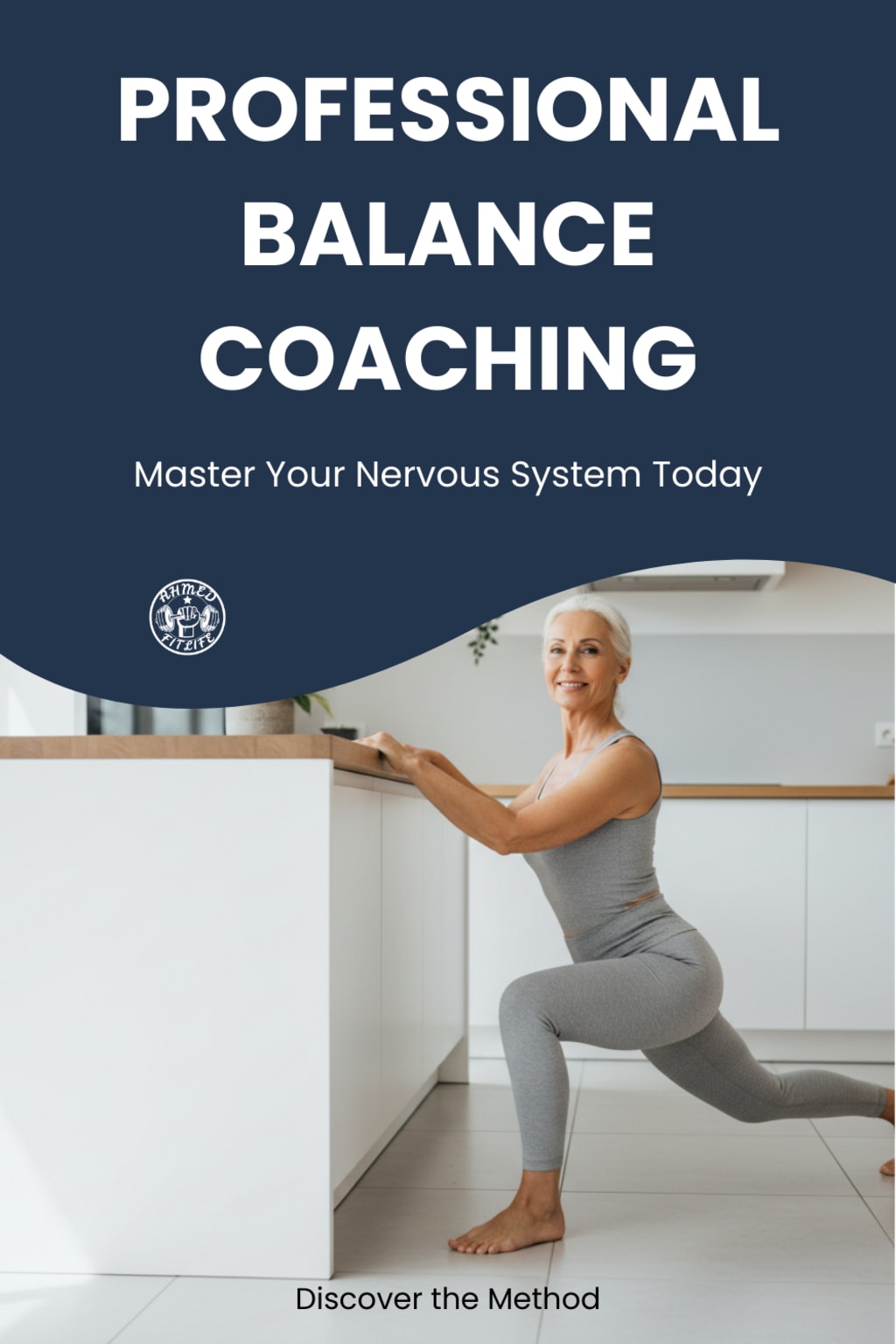
Balance is often misunderstood.
When stability declines, the default response is to build stronger legs or improve flexibility. While those strategies can help, they overlook a more important factor: balance is primarily governed by the central nervous system.
The brain does not simply command muscles to contract. It organizes information, predicts movement demands, and activates muscles in precise sequence. This orchestration is known as neuromuscular control and it is the foundation of coordinated movement.
For improving senior balance, strengthening the nervous system’s timing and communication patterns may be more impactful than increasing muscle mass alone.
The Central Nervous System as Movement Director
Every movement begins in the brain.
Before you take a step, your central nervous system has already processed sensory information from your feet, joints, eyes, and inner ear. It anticipates how much force is required, which stabilizing muscles should engage and how to maintain alignment.
This pre-activation is essential.
If neural activation occurs too late or too weakly, instability follows. The body may overcorrect or stiffen in response. Over time, this creates guarded movement patterns — shorter strides, reduced speed and cautious posture.
The issue is not simply weakness. It is timing.
Coordination training addresses this timing.
Understanding Neuromuscular Control
Neuromuscular control refers to the nervous system’s ability to recruit muscles efficiently and in the correct order.
Think of it as choreography.
For example, when stepping onto uneven ground:
The foot detects the surface change.
Sensory receptors send information to the brain.
The central nervous system processes the input.
The body adjusts posture to maintain balance.
This entire process occurs in milliseconds.
When neuromuscular control is refined, corrections are subtle and smooth.
When it is compromised, movements become exaggerated or delayed.
Therapeutic exercise focused on coordination training improves this choreography.
Why Senior Balance Requires a Neurological Approach
As we age, changes occur not only in muscle strength but also in neural activation speed and sensory accuracy.
The nervous system may:
Process signals more slowly
Recruit muscles less efficiently
Experience reduced proprioceptive clarity
Delay stabilizing responses
These changes are often gradual and go unnoticed until instability becomes apparent.
Improving senior balance therefore requires retraining how the nervous system interprets and responds to information.
This is where professional balance coaching becomes valuable.
Coordination Training: Teaching the Body to Respond Faster
Coordination training emphasizes precision over intensity.
Rather than focusing on how much weight is lifted, it focuses on how accurately and quickly muscles respond.
Examples include:
Slow, controlled weight shifts
Gentle single-leg balance holds
Transitional movements practiced deliberately
Each repetition reinforces neural activation.
Over time, the central nervous system becomes more efficient at anticipating and correcting instability.
The result is smoother and more confident movement.
Therapeutic Exercise as Neural Conditioning
The term therapeutic exercise often evokes images of rehabilitation clinics. However, its principles apply broadly to balance improvement.
Therapeutic exercise is structured to:
Strengthen stabilizing muscles
Improve joint alignment
Enhance sensory feedback
Reinforce coordinated movement patterns
Importantly, it integrates neuromuscular control rather than isolating muscle groups.
For senior balance, exercises that combine light resistance with controlled movement can strengthen both muscular and neurological pathways simultaneously.
This dual focus supports long-term stability.
Neural Activation and Anticipatory Control
One of the most overlooked aspects of balance is anticipatory activation.
Before you reach forward or turn quickly, your nervous system activates stabilizing muscles in preparation. This anticipatory control prevents loss of balance.
If neural activation is delayed, corrective responses occur after instability begins.
Coordination training sharpens this anticipatory timing.
By practicing gradual increases in movement complexity, individuals train the central nervous system to prepare more effectively for dynamic challenges.
This preparation improves overall movement efficiency.
The Relationship Between Confidence and Neuromuscular Control
Balance is not purely mechanical; it is psychological.
When the nervous system responds reliably, confidence grows.
Confidence encourages natural stride length, upright posture and relaxed movement.
Conversely, when neuromuscular control feels uncertain and protective stiffness develops. The body becomes rigid in an attempt to prevent instability.
Ironically, rigidity reduces adaptability.
By improving neural activation through coordination training and therapeutic exercise.
This psychological shift reinforces continued practice.
Professional Balance Coaching Beyond the Clinic
Professional balance coaching integrates neurological principles into practical routines.
Rather than focusing solely on repetition, it emphasizes:
Intentional alignment
Controlled progression
Sensory awareness
Consistency
In many cases, these methods can be practiced through structured home therapy routines.
Home therapy offers a practical advantage: frequency.
The central nervous system adapts through repetition. Short daily sessions often produce more sustainable improvement than infrequent, intense workouts.
When therapeutic exercise becomes part of a consistent routine, neural pathways strengthen gradually.
Why Strength Alone Falls Short
Strength is necessary, but it is not sufficient.
Consider two individuals with equal leg strength. One has refined neuromuscular control; the other has delayed neural activation.
When confronted with an unexpected surface change, the first responds instantly. The second hesitates.
The difference lies in coordination training and neural efficiency.
Improving senior balance therefore requires integrating strength with neurological refinement.
This integration ensures muscles are not only capable of producing force but are activated at the right moment.
The Future of Senior Balance Training
As research continues to explore motor control, rehabilitation approaches increasingly emphasize nervous system retraining.
Physical therapy programs now frequently incorporate:
Reactive balance drills
Sensory integration challenges
Progressive coordination sequences
Targeted neural activation exercises
These strategies reflect a broader understanding of biomechanics.
Movement is not simply mechanical. It is informational.
The body performs according to the clarity and speed of signals it receives.
A New Framework for Stability
To improve senior balance effectively, the framework must shift from “strength first” to “communication first.”
That communication is governed by the central nervous system.
Coordination training sharpens timing.
Therapeutic exercise reinforces stability.
Neuromuscular control refines muscle.
Neural activation ensures timely response.
Together, these elements create a comprehensive approach to balance.
Stability as a Trainable Skill
Perhaps the most encouraging insight is that balance remains trainable.
The nervous system retains adaptability throughout life. With consistent practice, neural pathways strengthen.
Improvements may begin subtly:
Slightly faster corrections
Smoother transitions
Reduced sway
Greater ease during walking
Over time, these small changes accumulate.
Movement becomes more fluid.
Confidence increases.
Stability feels less like effort and more like instinct.
Final Reflection
Professional balance coaching recognizes what traditional strength training sometimes overlooks: the nervous system is the true driver of movement.
By prioritizing coordination training, therapeutic exercise, and refined neuromuscular control, individuals can enhance senior balance in a way that addresses root causes rather than symptoms.
The body moves according to the signals it receives.
When those signals are clear, timely, and efficient, stability follows naturally.
Balance is not just a physical attribute.
It is a neurological skill — one that can be strengthened, refined and maintained through deliberate practice.
About the Creator
AhmedFitLife
Helping You Reclaim Balance, Energy & Focus Naturally
Hi, I’m Ahmed, Discover Neuro-Balance Therapy! 🌿 Reduce stress, boost focus, and restore balance with this easy, guided tool. Feel better, naturally: Neuro-Balance Therapy
Keep reading
More stories from AhmedFitLife and writers in Longevity and other communities.
The Biomechanics of Better Steps
Most people assume that better walking begins with stronger muscles. Walking is not just a muscular act — it is a neurological performance. Every step is shaped by a constant exchange of information between your feet and your brain. This communication system, known as the sensory motor network, determines how stable and confident your movement feels.
By AhmedFitLifea day ago in Longevity
What Happens to Your Body When You Skip Meals Regularly
“I’ll eat later.” “I’m not that hungry.” “I’m too busy.” For many university students, skipping meals feels normal. But when student irregular eating becomes a habit, your body starts responding in ways you might not immediately notice.
By Being Inquisitive4 days ago in Longevity
The Weight of a Touch: Why My best Training Equipment Isn't made of Iron
The Weight of a Touch: Why My Best Training Equipment Isn't Made of Iron The air in a commercial gym is thick with more than just the smell of rubber mats and recycled oxygen. If you stop moving for a second and just observe, you’ll feel it—a heavy, invisible fog of human ambition, deep-seated anxiety, and the restless energy of people trying to outrun their own shadows. Most personal trainers see this environment as a simple workspace where calories are burned and muscles are built. But for me, the gym floor is a sanctuary where two souls meet in a very raw, vulnerable state. And because of what I’ve survived, I refuse to walk onto that floor without a very specific kind of protection.
By Feliks Karić4 days ago in Longevity
When the Shelter Closes
Across the street from my house, a man slept under a tree, his dog by his side. My first, naive thought: he must be traveling through. But he kept coming back, often sleeping there during the day. Then it hit me—that person might not have a home.
By Bride of Sound4 days ago in Humans



Comments
There are no comments for this story
Be the first to respond and start the conversation.