
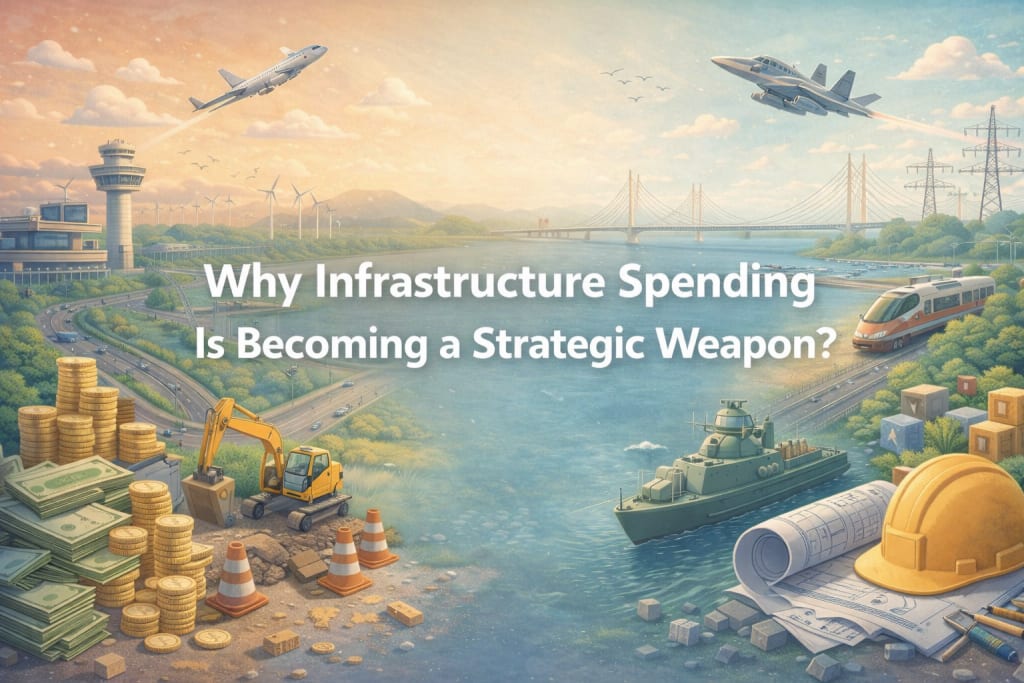
Why Infrastructure Spending Is Becoming a Strategic Weapon?
As digital economies mature and competition shifts from visible products toward underlying systems, infrastructure investment has moved from a technical necessity to a strategic instrument used to shape market dominance, influence industry direction, and define the pace at which entire sectors advance.

A decade ago, infrastructure spending rarely captured headlines outside engineering circles. Data centers, network cables, semiconductor fabs, and cloud capacity were viewed as background mechanics — essential but largely invisible to users and investors alike.
Today, infrastructure has stepped into the foreground.
Major technology companies announce multi-billion-dollar investments in data centers with the same fanfare once reserved for consumer product launches. Governments compete to attract semiconductor manufacturing. Cloud providers race to expand global regions. Even startups discuss infrastructure positioning as a defining factor in their growth plans.
The shift signals something deeper than scaling demand. Infrastructure spending has become a strategic tool — a way to influence competitors, shape developer ecosystems, and control the future direction of technology markets.
The Quiet Power Behind Competitive Advantage
Infrastructure shapes outcomes long before consumers encounter finished products.
When a company invests in computing capacity, logistics networks, or specialized hardware, it gains leverage over speed, cost structure, and availability. These advantages compound over time.
According to the Synergy Research Group, global spending on cloud infrastructure services surpassed $270 billion in 2024, reflecting year-over-year growth of roughly 20%. What stands out is not only the size of the market but its concentration. A small number of providers dominate capacity, allowing them to influence pricing models and service standards across industries.
The International Data Corporation (IDC) estimates that over 75% of enterprise workloads will run on cloud platforms by 2027, up from roughly 45% in 2021. Infrastructure ownership increasingly determines who controls the flow of enterprise software.
When infrastructure providers expand capacity, they do more than meet demand. They shape what becomes economically feasible for others to build.
Artificial Intelligence and the Infrastructure Arms Race
Artificial intelligence has intensified infrastructure competition.
Training advanced AI systems requires enormous computational resources, specialized chips, and high-performance networking. Nvidia’s data center revenue, driven largely by AI demand, increased by more than 200% between 2022 and 2024, highlighting the scale of hardware dependency.
The International Energy Agency reports that global data center electricity consumption may reach nearly 1,000 terawatt-hours annually by the end of the decade — roughly equivalent to the total electricity use of a mid-sized industrialized nation.
These numbers reveal why infrastructure has become strategic territory.
Companies that control high-performance computing environments gain influence over who can build advanced AI systems, how quickly they can iterate, and how expensive experimentation becomes.
Elon Musk once remarked that “AI is a race not just of algorithms but of compute.” Whether or not one agrees with his framing, the resource requirements illustrate how infrastructure can determine technological direction.
Semiconductor Manufacturing as Geopolitical Strategy
Infrastructure spending extends beyond corporate competition into national policy.
Semiconductor fabrication plants — often costing more than $10 billion each — have become symbols of economic security. The U.S. CHIPS and Science Act allocated over $52 billion to domestic semiconductor manufacturing and research, aiming to reduce reliance on overseas supply chains.
Meanwhile, South Korea’s government announced plans to support a semiconductor cluster projected to attract more than $450 billion in private investment over the coming decades. Taiwan Semiconductor Manufacturing Company (TSMC) continues expanding global facilities to meet demand for advanced chips.
These investments highlight a shift in thinking. Infrastructure is no longer viewed solely as operational overhead. It is a strategic asset tied to economic resilience and technological leadership.
Latency, Geography, and the Race for Proximity
Cloud providers increasingly invest in regional infrastructure to reduce latency and improve performance.
According to a report from Cloudflare, nearly 60% of internet traffic now originates from mobile devices. As real-time applications such as gaming, streaming, and AI-powered tools become more common, milliseconds of delay matter.
Edge computing — distributing processing closer to users — represents another front in infrastructure competition. Gartner predicts that by 2026, 75% of enterprise-generated data will be processed outside traditional centralized data centers, compared with less than 25% in 2018.
Companies that build dense networks of edge locations can deliver faster experiences, creating subtle but powerful competitive advantages.
Infrastructure becomes a differentiator not visible in marketing campaigns but experienced through performance.
Infrastructure as an Economic Moat
Building infrastructure requires enormous capital. This creates barriers that smaller competitors struggle to overcome.
A report from UBS found that the top five cloud providers collectively spend over $120 billion annually on capital expenditures related to data centers, networking equipment, and hardware. Such investment levels deter new entrants, reinforcing existing market positions.
Jeff Bezos once described infrastructure investment as “planting seeds you won’t harvest for years.” Long timelines discourage short-term competitors while rewarding companies willing to commit resources early.
The result is a feedback loop: large companies invest heavily, which strengthens their dominance, enabling further investment.
This dynamic extends into software distribution. Companies building applications — including those working within mobile app development Seattle — must consider infrastructure ecosystems when planning scalability and performance strategies.
Where software runs often matters as much as how it is designed.
The Financialization of Infrastructure
Infrastructure spending has also attracted financial markets.
Private equity firms and sovereign wealth funds increasingly invest in data centers, fiber networks, and cloud capacity. According to CBRE’s global data center trends report, investment into digital infrastructure assets grew by more than 30% between 2021 and 2024.
Investors view infrastructure as a stable revenue source due to long-term contracts and recurring usage fees.
Telecommunications companies illustrate this trend. Many have spun off tower infrastructure into separate entities, monetizing underlying assets while maintaining operational control.
Infrastructure becomes both a strategic weapon and a financial instrument.
Sustainability Pressures and Energy Strategy
Energy consumption has become a defining factor in infrastructure planning.
Google reports that its data centers now operate with an average power usage effectiveness (PUE) of approximately 1.10, compared to industry averages closer to 1.55. Efficiency improvements reduce costs while addressing environmental concerns.
Microsoft has pledged to achieve carbon-negative operations by 2030, partly through investment in renewable-powered infrastructure. These initiatives highlight how environmental strategy intersects with competitive positioning.
Companies capable of building energy-efficient infrastructure may gain cost advantages as electricity prices fluctuate and sustainability regulations tighten.
Control Over Standards and Developer Ecosystems
Infrastructure spending also influences standards.
Cloud providers offer proprietary tools, databases, and AI services that encourage developers to build within specific environments. Over time, these tools shape how software is designed and deployed.
A 2024 developer survey conducted by JetBrains found that 68% of respondents rely heavily on cloud-native services when building applications. While these services accelerate development, they also create dependencies that reinforce ecosystem loyalty.
Infrastructure defines boundaries within which developers operate.
The Future: Invisible Battles Beneath Visible Products
Consumers rarely think about infrastructure directly. They experience it indirectly — through faster streaming, smoother video calls, or responsive applications.
Yet beneath those experiences lies an escalating competition centered on capacity, proximity, and control.
Three trends appear likely to shape the next phase:
First, infrastructure spending will increasingly align with artificial intelligence demands, as companies compete to build specialized compute environments.
Second, geographic distribution will become more important as real-time applications grow, pushing providers toward localized infrastructure expansion.
Third, partnerships between governments and private companies will intensify, particularly around semiconductor manufacturing and digital sovereignty.
A Strategic Shift Hidden in Plain Sight
Infrastructure once represented the background of technological progress. Today it functions as a strategic lever capable of reshaping industries.
The shift reflects a broader realization: whoever controls the foundation often shapes the future direction of the market built on top of it.
While product launches continue to capture attention, the deeper competition unfolds in data centers, fiber routes, semiconductor fabs, and energy contracts.
These investments may not generate immediate headlines, but they determine who sets the pace — and who must follow.
In an era defined by scale and interconnection, infrastructure spending has evolved from necessity into strategy, quietly redefining how power operates in the digital economy.
About the Creator
Keep reading
More stories from Samantha Blake and writers in Proof and other communities.
Top 10 Ecommerce App Development Companies in USA 2026
The ecommerce industry is no longer just growing — it is transforming at a pace that leaves unprepared businesses behind. Global ecommerce sales are projected to surpass six trillion dollars in 2026, and mobile commerce alone accounts for the lion's share of that growth. Whether you are launching a direct-to-consumer brand, building a multi-vendor marketplace, or digitizing an established retail business, the foundation of your success is the app you put in front of your customers.
By Samantha Blakea day ago in 01
Irresistible Chocolate Cocktails: Sweet Treats for Dessert Lovers
Chocolate and cocktails are a match made in heaven. When the rich, velvety taste of cocoa meets the spirited kick of alcohol, magic happens. Whether you want to impress guests or just treat yourself after dinner, chocolate cocktails offer that perfect blend of sweetness and indulgence. These drinks are dessert in a glass, smooth and luscious, with enough complexity to keep your palate intrigued.
By Marcus Petrovabout 4 hours ago in Proof




Comments
There are no comments for this story
Be the first to respond and start the conversation.