
U.S. strategic competition with China.
strategic importance of the Strait of Hormuz

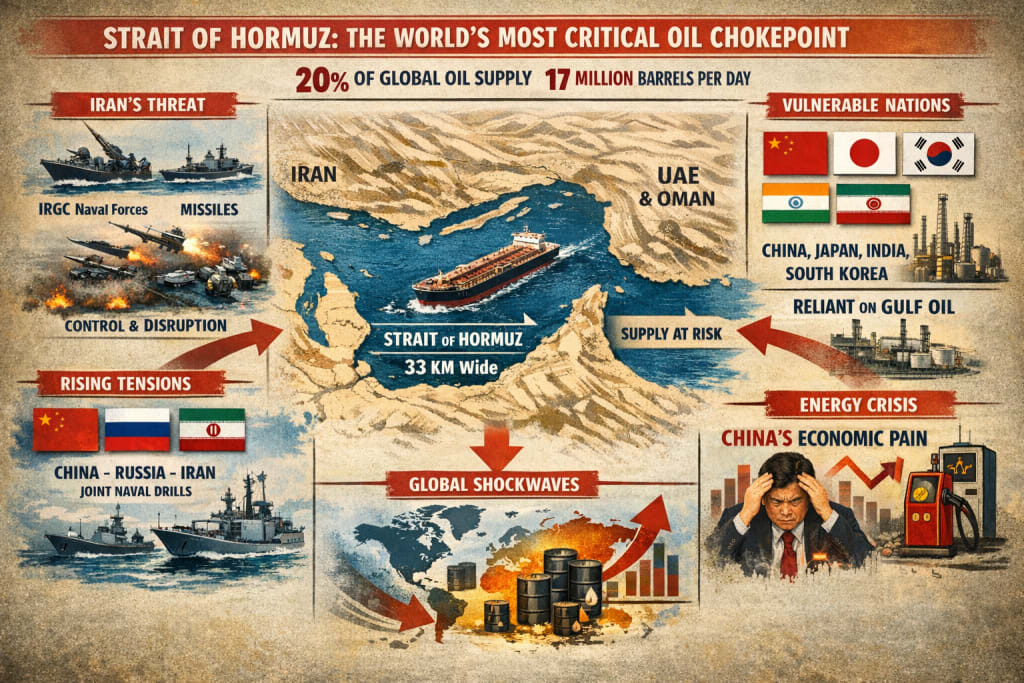
This war Stop being a medley story the moment the first oil tanker changed course in the Persian Gulf. What I mean is, Strait of Hormuz is the most important energy bottleneck on earth. Everybody knows it is the most important energy bottleneck on earth. And if it was the threat from Iran last time, this time Iran has partially done it. It is so narrow, IRGC has a lot of control over it. Just like in the Strait of Malacca, army/navy has control over it. Similarly, here the Iranians have control over it. And recently, China, Russia, and Iran have already conducted war games. So it is this narrow, 33 kilometers wide, you are hearing about it everywhere, everybody is talking about it. It is the width of a large city. So in this narrow passage, which holds 20% of the world's oil, one fifth of the world's oil and gas goes through, it is around 17 million barrels per day. There is no realistic alternative route except the Strait of Hormuz. If we close this passage, its consequences will not stop at any one border. Europe will pay, Japan will pay, India, South Korea, China, everybody pays the price. So a theory is floating around, which backs my argument that China is the target. It is that in Washington circles, there is a discussion going on, let's be honest, if this happens, what do we have to do? The hawkish people there say that this disruption should be allowed because it does not impact them as much as it impacts those countries, which I have just mentioned. So let's take this opportunity that the slowdown of China's energy supply can be slowed down. Trap Beijing in such an expensive moment as long as this congestion remains in the Strait of Hormuz, it remains closed, partially or completely. Iran keeps Beijing hit very badly from an energy security point of view. So the containment policy of China that is already going on is an added bonus. So imagine, on one hand, you are doing everything with technology and trade, imposing tariffs, treating them in the South China Sea, imagine all this. And from the other side, almost 90% of the oil and gas supplies go to China. If it is blocked for a few days, how badly it will hit China. So imagine, while the world is suffering, they are only having strategic designs in their minds.
1. Why the Strait of Hormuz Matters So Much
The Strait of Hormuz is widely considered the most critical energy chokepoint in the world.
Roughly 20% of the world’s petroleum liquids pass through it.
About 17–20 million barrels of oil per day transit this narrow route.
The strait is only about 33 km wide at its narrowest point, with shipping lanes even narrower.
Major exporters relying on it include:
Saudi Arabia
Iraq
Kuwait
United Arab Emirates
Qatar
Any disruption—mines, missile threats, naval harassment—can immediately spike global energy prices.
2. Iran’s Ability to Disrupt the Strait
Iran does not need to completely close the strait to cause chaos. Even partial disruption could create panic in energy markets.
Tools often discussed include:
Fast attack boats operated by the Islamic Revolutionary Guard Corps (IRGC)
Naval mines
Anti-ship missiles from the Iranian coast
Drone and swarm tactics
Because the strait lies directly along Iran’s coastline, it has geographic leverage.
3. Who Would Be Hit the Hardest
While a disruption would affect everyone, Asian economies depend most on Gulf energy.
Countries heavily reliant on oil flowing through the strait include:
China
India
Japan
South Korea
China in particular imports a very large portion of its crude from the Middle East, making this choke point extremely sensitive for Beijing’s energy security.
4. Why Some Analysts Link This to U.S.–China Rivalry
In strategic discussions in United States policy circles, some analysts argue that any disruption could hurt China more than the U.S..
Reasons often cited:
The U.S. now produces large amounts of oil domestically due to shale production.
China remains heavily dependent on imported energy.
A prolonged disruption could raise China’s economic costs and slow industrial output.
This is why some geopolitical commentators connect the issue to U.S. containment strategies toward China.
5. Military Cooperation Around the Region
Recently, naval cooperation between:
China
Russia
Iran
has included joint exercises in waters near the Persian Gulf and the Gulf of Oman. These drills are often interpreted as signals against Western naval dominance in the region.
6. The Reality: Everyone Loses
Even though geopolitical strategists may speculate about advantages, the reality is:
Global oil prices would spike dramatically.
Shipping insurance costs would explode.
Financial markets could panic.
Economic growth worldwide would slow.
That means Europe, Asia, and even the United States would feel the shock.
About the Creator
Ibrahim Shah
I am an Assistant Professor with a strong commitment to teaching,and academic service. My work focuses on fostering critical thinking, encouraging interdisciplinary learning, and supporting student development.
Keep reading
More stories from Ibrahim Shah and writers in The Swamp and other communities.
The Saddest Thing - The Billionaires Who Rule America Aren't Even Enjoying Themselves
This single post says more about our ruling class than a thousand policy papers. The saddest thing about today's system is that the men robbing the rest of us - sabotaging our economic prospects, our pensions, our access to affordable healthcare - are not even happy.
By Scott Christenson🌴28 days ago in The Swamp
Royal Navy Wildcat helicopters arrive to defend Cyprus
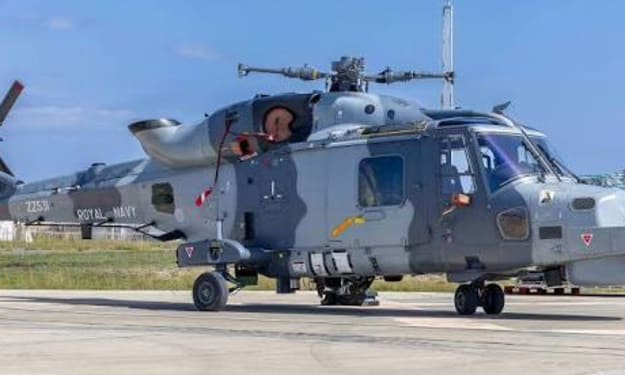
The United Kingdom has deployed advanced naval helicopters to Cyprus as part of a wider effort to strengthen defenses around the island amid rising tensions in the eastern Mediterranean. The arrival of the AgustaWestland AW159 Wildcat helicopters operated by the Royal Navy highlights growing concerns about regional security and the potential for further military escalation. The helicopters were transported to British sovereign bases in Cyprus, where they will support surveillance, air-defense coordination, and maritime security operations. British defense officials say the deployment is intended to protect personnel and infrastructure while ensuring that the United Kingdom can respond quickly to any emerging threats in the region. Strengthening Defenses at Strategic Bases Britain maintains two major sovereign base areas on Cyprus—RAF Akrotiri and Dhekelia—which have long served as strategic hubs for military operations in the Middle East and eastern Mediterranean. These installations allow the United Kingdom to conduct air operations, intelligence missions, and humanitarian support across a wide geographic area. The arrival of Wildcat helicopters enhances the defensive capabilities of these bases. Known for their advanced radar systems and agility, the helicopters are designed to conduct reconnaissance, maritime patrols, and anti-surface warfare operations. Their sensors allow crews to detect small vessels, drones, and other potential threats at sea or along coastlines. British officials say the aircraft will also work closely with naval vessels operating nearby, creating a layered defense network designed to protect both military personnel and regional shipping routes. Rising Regional Tensions The deployment comes at a time of heightened tensions across the Middle East and eastern Mediterranean. Conflicts involving Iran, Israel, and the United States have increased concerns that the conflict could spill into neighboring areas or threaten international shipping lanes. Cyprus, located at a crossroads between Europe, Asia, and the Middle East, has become an important staging point for military operations and evacuation missions. Western forces have used the island’s bases to support surveillance flights, humanitarian operations, and logistical support for regional allies. Security analysts note that Cyprus’s strategic location makes it both valuable and potentially vulnerable during periods of regional instability. Role of the Wildcat Helicopter The AW159 Wildcat represents one of the most modern helicopters currently used by the Royal Navy. Designed for multi-role operations, the aircraft can carry precision-guided missiles, torpedoes, and advanced surveillance systems. Its compact size allows it to operate from both naval ships and land bases. Military planners often deploy the Wildcat in situations where flexibility and rapid response are required. The helicopter’s sensors can track multiple targets simultaneously, while its communication systems allow it to coordinate with ships, aircraft, and ground forces. Experts say these capabilities make the Wildcat particularly valuable in scenarios involving drone threats, small attack boats, or other fast-moving targets that can challenge traditional air-defense systems. A Broader Security Strategy British defense officials emphasize that the helicopter deployment is part of a broader strategy aimed at maintaining stability in the region. The United Kingdom continues to work with NATO partners and regional allies to monitor security developments and deter potential threats. In addition to the Wildcat helicopters, Britain has strengthened naval patrols and increased intelligence-sharing efforts with partner nations operating in the Mediterranean. These measures are intended to protect international shipping routes and prevent further escalation of regional conflicts. For Cyprus, the presence of additional British military assets reflects both the island’s strategic importance and the growing complexity of the regional security environment. Looking Ahead While British officials describe the deployment as precautionary, analysts say it highlights the fragile state of security in the eastern Mediterranean. As conflicts elsewhere in the region continue to evolve, Cyprus is likely to remain a key operational hub for Western forces. The arrival of the Royal Navy’s Wildcat helicopters underscores the United Kingdom’s commitment to protecting its overseas bases and maintaining a military presence capable of responding to rapidly changing threats.
By Fiaz Ahmed about 8 hours ago in The Swamp


Comments (1)
Thanks!