Latest Stories
Most recently published stories in Unbalanced.
Johnny Gaudreau: A Small Star Who Skated Big Dreams
Hockey has always loved its giants. Big bodies. Heavy hits. Long reaches. For years, size felt like destiny in the NHL. If you were smaller than the rest, you were expected to fight twice as hard just to stay on the ice.
By Muqadas khan7 days ago in Unbalanced
Norway’s Record Olympic Medal Haul Is a Welcome Distraction From Scandal. AI-Generated.
At the 2026 Winter Olympics in Milan‑Cortina, Norway achieved an extraordinary milestone: a record number of Olympic medals that outpaced all previous Winter Games performances by any nation. The achievement has captivated fans and boosted national pride — and it couldn’t have come at a more opportune moment for a country grappling with controversy off the ice and snow. As Norway’s athletes climbed podiums in disciplines ranging from cross‑country skiing to biathlon and speed skating, the nation found a unifying story of success that has momentarily pushed aside headlines about a scandal involving its national Olympic federation. A Historical Performance With more than 40 medals — including double‑digit golds — Norway’s performance topped the medal table once again and reinforced its status as a Winter Games powerhouse. Norway’s dominance in cross‑country skiing continued unabated, with athletes such as Jarl Magnus Riiber and Ingrid Landmark Tandrevold delivering standout performances that thrilled crowds and secured multiple golds. Even in events where Norway has historically been less dominant, such as figure skating and alpine combined, Norwegian competitors contributed key points to the country’s tally. “It’s the culmination of years of investment in youth sport, coaching, and athlete support,” said a senior official with Olympiatoppen, the elite division of the Norwegian Olympic and Paralympic Committee and Confederation of Sports. “Our athletes are world‑class across the board, and they’ve shown it here.” Scandal at Home Casts a Shadow The timing of Norway’s record haul has been especially welcome given recent negative headlines involving the Norwegian Olympic Federation. Weeks before the Games began, a major investigation revealed that several senior officials had been implicated in mismanagement of funds earmarked for athlete support and development. The reports, published by leading Norwegian media outlets, described alleged misuse of government grants and sponsorship money, triggering public outcry and calls for resignations. The scandal dominated domestic news cycles and sparked debate about governance and transparency within Norway’s sporting institutions. Some sponsors threatened to withdraw funding, and several athletes expressed concern that the controversy could overshadow their preparations. Sport as a Unifying Force But as the Winter Games unfolded and Norwegian victories began to accumulate, the narrative shifted. Images of jubilant athletes draped in red, white, and blue flags began circulating around the world, and social discourse in Norway increasingly focused on sporting achievement rather than federation turmoil. “For a moment, we are united,” said sports commentator Anne Lise Johansen on national television. “Norway’s success at the Olympics gives people something positive to talk about.” Citizens shared their pride on social media, with many Norwegians expressing gratitude that their athletes’ achievements were lifting spirits and providing an escape from ongoing controversies. Schools and community centers held viewing parties, and local broadcasters scheduled special coverage celebrating Norway’s victories. Balancing Success and Scrutiny Despite the celebratory mood, some commentators warn that histrionic pride should not let the federation scandal fade from public scrutiny. Legal experts note that the investigation into financial mismanagement is ongoing, and potential reforms to oversight structures may still be necessary. “We cannot let Olympic glory distract us indefinitely,” said a law professor at the University of Oslo. “If governance issues aren’t addressed, similar problems could arise again down the line.” For many athletes, however, the focus remains squarely on performance and the camaraderie of competition. Several medallists publicly acknowledged the support of coaches, family members, and national fans, attributing their success to years of dedication rather than institutional politics. “We train hard to represent Norway with pride,” said a Norwegian speed skater after winning an Olympic medal. “What happens on the track or the snowfield is what matters to us right now.” Looking Ahead As Norway prepares to bring its athletes home, celebrations are expected to continue across the country. While the federation scandal has not disappeared — and is likely to be revisited by media and lawmakers — the record Olympic medal haul offers a compelling counterweight. For a nation that thrives on winter sport, these Games have provided a story of excellence and resilience that resonates beyond medals and into the cultural fabric of Norwegian life.
By Fiaz Ahmed 7 days ago in Unbalanced
Tyson Fury Fight 11/4/2026
Tyson Fury is coming out of retirement again, and the boxing world is wide awake because of it. April the 11th, 2026, is the date being spoken about, and already you can feel that restless energy building. Some fighters leave quietly, some fade, but Fury never does anything small. He walks away loud, and he returns even louder.
By Marie381Uk 7 days ago in Unbalanced
Israel Disqualifies Its Own Olympic Bobsleigh Team for Lying to Officials. AI-Generated.
In an unusual and dramatic turn of events at the 2026 Winter Olympics in Cortina d’Ampezzo, Israel’s four-man bobsleigh team was disqualified by its own national Olympic committee after team members submitted a false medical claim in an attempt to include a substitute athlete. The decision was announced by the Olympic Committee of Israel in a statement condemning the conduct as antithetical to fair play and Olympic values. The controversy unfolded on Sunday, 22 February 2026, amid the four-man bobsleigh competition. Earlier in the Games, the Israeli crew — consisting of AJ Edelman, Menachem Chen, Uri Zisman, and Omer Katz — completed two heats and finished 24th out of 27 sleds following a race that saw three other teams crash during their second run. Times of Israel What Went Wrong The dispute centers on an attempted lineup change that would have allowed Ward Fawarseh — the team’s alternate — to compete in place of Zisman. If Fawarseh had taken the ice, he would have made history as Israel’s first Druze Olympian, a landmark moment for representation in the Games. However, according to officials, substitutions in bobsleigh are strictly governed by Olympic regulations. An alternate may only replace a team member when that athlete is verified to be injured or ill by medical assessment. Attempting to circumvent this rule led to the team’s undoing. To make the substitution legitimate, one of the squad’s athletes claimed to be unwell, underwent a medical examination, and signed an affidavit — all to satisfy the formal requirements for a swap. Afterward, however, the athlete admitted to delegation leadership that the injury claim was fabricated, and that the substitution scheme had been premeditated. In light of the admission, the Olympic Committee of Israel withdrew its request to the International Olympic Committee (IOC) and opted to disqualify the team from further competition. The Israeli committee’s statement described the conduct as “improper” and “inconsistent with the principles of fair play and sportsmanship expected of Olympic athletes.” Responses From the Team In a post on social media, team pilot AJ Edelman acknowledged that the circumstances surrounding the attempted substitution “did not meet the high bar” required for a legitimate lineup change. He said the decision to withdraw from the final run was made with regret. Times of Israel Edelman added that although the team was not in medal contention, their overarching motivation was to give Fawarseh the opportunity to compete. “It was more important to us that our alternate could have the opportunity to compete in the Olympics,” he wrote, while also expressing pride in what the crew had achieved in representing Israel. Times of Israel Broader Context at the Games The bobsleigh squad had already garnered attention throughout the Milan-Cortina Games not only for its on-track performance but also for controversies related to broadcasting and commentary. Earlier coverage by broadcasters, including remarks about the team’s presence, drew criticism and required apologies, highlighting the heightened scrutiny experienced by the Israeli delegation. For Israel’s Olympic contingent — which this year includes athletes across several winter disciplines — the disqualification represents a symbolic setback at a Games where medals have been difficult to come by. Nonetheless, other competitors such as Israeli skier Barnabas Szollos are still scheduled to participate and even carry the national flag during the closing ceremony. Times of Israel Fairness, Rules, and Olympic Integrity The decision by Israel’s Olympic Committee to disqualify its own team underscores the importance placed on integrity and compliance with international competition rules, even at the cost of historic individual milestones. Olympic officials have stressed that adherence to regulations safeguards the credibility of competition and ensures a level playing field for all participants. While the bobsleigh team will not compete further in the event, the incident serves as a reminder that the Olympic spirit demands not just athletic excellence, but respect for the rules and ethical conduct that govern global sport.
By Fiaz Ahmed 7 days ago in Unbalanced
Tennessee vs Vanderbilt: More Than a State Rivalry
When Tennessee vs Vanderbilt appears on the schedule, it feels different. The air carries history. Families pick sides. Old memories return. Some remember heartbreak. Others remember last-minute wins that still give them chills.
By Muqadas khan8 days ago in Unbalanced
PSG vs Metz: More Than Just Another Ligue 1 Night
Some football matches feel routine. Others carry quiet tension long before kickoff. PSG vs Metz may not always dominate global headlines like a European final, yet it holds its own emotional weight. For Paris Saint-Germain supporters, every match is about defending status and chasing perfection. For Metz fans, facing a giant like PSG brings a mix of fear, pride, and belief. On paper, the gap between the two clubs looks wide. In reality, football rarely follows paper logic. A single counterattack, a missed penalty, or a red card can rewrite expectations in seconds. That unpredictability is what makes PSG vs Metz more than just another Ligue 1 fixture. It is a reminder that in football, history matters, but the present moment decides everything.
By Muqadas khan8 days ago in Unbalanced
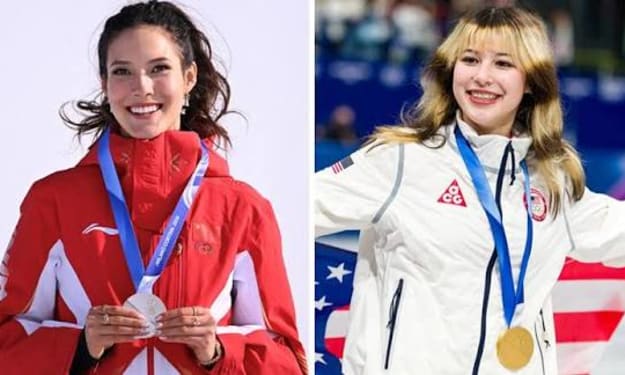
Alysa Liu vs Eileen Gu — How Two Chinese American Stars Wound Up on Opposite Sides of an Olympic Proxy War. AI-Generated.
The rivalry between Alysa Liu and Eileen Gu has come to symbolize more than athletic competition. As both athletes rise to global prominence at the Winter Olympics, their contrasting national affiliations have turned them into unlikely figures in a broader geopolitical struggle between the United States and China. Though they share Chinese heritage and were both raised in the United States, Liu and Gu have made different choices about which flag to represent. Those decisions have placed them at the center of heated debate over identity, loyalty, and the politicization of sport. Two Paths from Similar Beginnings Alysa Liu grew up in California and became one of America’s most promising figure skaters at a young age, winning national titles and emerging as a symbol of the U.S. skating future. She competes under the American flag and has consistently emphasized her identity as an American athlete shaped by the U.S. training system. Eileen Gu, by contrast, made headlines when she chose to compete for China despite being born and raised in San Francisco. Her decision transformed her into a national celebrity in China and a marketing icon with sponsorship deals and widespread media coverage. Both athletes have said their choices were personal and rooted in family ties and opportunity rather than politics. Yet their visibility has ensured that their decisions are interpreted politically whether they intend it or not. Media and Public Reaction In the United States, Gu’s decision sparked controversy and accusations of divided loyalty, while others defended her right to define her own identity. In China, she was celebrated as a homegrown champion returning to her cultural roots. Liu, meanwhile, has been portrayed by American media as a symbol of domestic talent and perseverance, with her Olympic performances framed as part of the U.S. sporting narrative. Chinese social media users have sometimes contrasted her path with Gu’s, turning two athletes into symbols of competing national pride. “Neither athlete asked to become a political statement,” said one sports sociologist. “But in today’s climate, elite athletes with dual cultural identities are inevitably drawn into geopolitical narratives.” Sport as a Proxy Battleground The rivalry reflects how the Olympics increasingly function as a stage for soft power competition. Medal counts and star athletes are viewed as reflections of national systems and global influence. Gu’s success for China has been presented domestically as proof that China can attract global talent and compete with Western sports powers. Liu’s performances for the United States reinforce the American emphasis on individual achievement and freedom of choice. This dynamic has fueled what some commentators call an “Olympic proxy war,” where athletic outcomes become symbolic victories in a wider ideological contest. Personal Cost Both athletes have faced intense scrutiny online. Gu has been targeted by critics in the U.S. accusing her of exploiting opportunities in both countries. Liu has endured pressure to perform not only as an athlete but as a representative of American values. Friends and coaches say the athletes have tried to shield themselves from political commentary and remain focused on training. Yet the weight of expectations is difficult to escape. “These are young women who want to skate and ski,” said a former Olympic coach. “Instead, they’re being treated like diplomats.” What It Says About Identity The Liu-Gu divide highlights a deeper tension faced by many Chinese Americans navigating multiple cultural identities in a polarized world. Their stories show how personal heritage can be reframed as political allegiance under international spotlight. Rather than a simple rivalry, their parallel careers illustrate two valid expressions of identity: one rooted in birthplace and opportunity, the other in heritage and cultural connection. Looking Ahead As future Olympic Games approach, both athletes are expected to remain central figures in their respective national teams. Whether their rivalry continues to be framed politically may depend less on them and more on the evolving relationship between Washington and Beijing. For now, Alysa Liu and Eileen Gu remain linked in public imagination — not because they compete directly, but because their choices represent opposite sides of a cultural and political fault line that extends far beyond sport. Their journeys remind the world that in the modern Olympics, medals are no longer just about athletic excellence. They are also about identity, narrative, and the power of symbols in an age of global rivalry.
By Fiaz Ahmed 8 days ago in Unbalanced
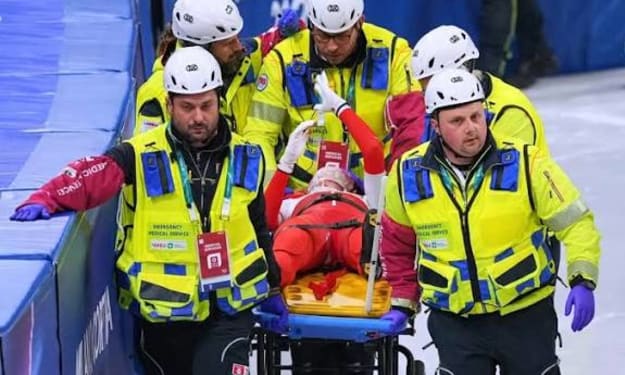
Poland’s Kamila Sellier Stretchered Off After Opponent’s Blade Slices Above Her Eye in Olympic 1500. AI-Generated.
A dramatic and frightening incident unfolded during the women’s 1500-meter speed skating event at the Winter Olympics, when Polish skater Kamila Sellier was seriously injured after an opponent’s skate blade sliced above her eye, forcing officials to halt the race and rush medical teams onto the ice. Sellier collided with another competitor while entering a tight corner at high speed. Witnesses reported that she lost balance and fell forward, at which point the sharp blade of another skater’s boot struck her face just above the eyebrow. Blood was immediately visible, prompting referees to stop the race within seconds as medics sprinted to her aid. Emergency Response on the Ice Medical personnel surrounded Sellier as she lay motionless on the ice. She was quickly stabilized, placed on a stretcher, and taken to a nearby medical facility for further evaluation. Organizers later confirmed that she remained conscious and responsive during transport, though the full extent of her injury was not immediately disclosed. Officials said she sustained a deep laceration near her eye and would undergo scans to rule out facial fractures or internal injuries. “Our priority was to ensure her safety and provide immediate medical attention,” an Olympic medical spokesperson said. The competition was suspended for nearly 20 minutes as staff cleared the ice and reassured shaken athletes. When racing resumed, the mood in the arena was visibly subdued. A High-Risk Sport Speed skating is one of the fastest events in the Winter Olympics, with athletes reaching speeds of over 50 kilometers per hour while skating in close proximity. Although protective gear is worn, including cut-resistant suits and helmets, facial injuries remain a known risk due to exposed areas around the eyes and nose. Experts note that accidental contact with blades, though rare, can lead to severe injuries. “This sport combines speed, tight corners, and sharp equipment,” said a former Olympic skater turned safety analyst. “Incidents like this remind us how dangerous it can be despite modern protections.” Reaction from Teammates and Rivals Polish team officials described the incident as “devastating” for both Sellier and her teammates. “Kamila was in strong form and had trained for years for this moment,” a team spokesperson said. “Our thoughts are entirely with her and her family.” Other competitors expressed shock and concern, with several skaters seen visibly emotional following the crash. One rival athlete said, “We all know accidents happen, but seeing someone hurt like that is terrifying. We just hope she recovers fully.” The athlete whose blade caused the injury was not blamed for the collision, and officials stated that the crash appeared accidental with no rule violations. Questions About Safety Measures The incident has reignited discussion about safety standards in short- and middle-distance speed skating. Some experts are calling for stronger face protection or redesigned helmets to reduce the risk of blade-related injuries. While international skating bodies have previously debated full face shields, many athletes resist them due to visibility issues and discomfort. However, Sellier’s injury may prompt renewed evaluation of whether current equipment is sufficient. “Technology in sports safety must evolve as performance speeds increase,” said a sports medicine specialist. “We should always ask whether more can be done to protect athletes without compromising competition.” Looking Ahead As of the latest update, Sellier remains under medical observation and is unlikely to compete again in the current Olympic Games. Her participation in future events will depend on recovery time and medical clearance. The Polish Olympic Committee said it would issue further statements once doctors complete their assessment. Fans across Poland flooded social media with messages of support, wishing her a swift and complete recovery. A Sobering Moment The accident cast a shadow over what is usually one of the most thrilling events of the Winter Games. While the competition continued, attention remained focused on Sellier’s condition rather than the medal standings. The episode served as a stark reminder of the physical risks elite athletes take in pursuit of Olympic glory. As spectators applauded her bravery, many also reflected on the fine line between sporting excellence and serious injury in high-speed winter sports.
By Fiaz Ahmed 8 days ago in Unbalanced
Somers Swishes Another Thrilling Comeback versus Hen Hud
Scroll down for girls photos and boys vs Nanuet On Friday, January 30, Somers welcomed Hen Hud to the High School, and Kate Stratton looked like she was going to make it a very long afternoon for her hosts. Four straight jumpers, a 10-3 lead forced adjustment. “We didn’t let her get the ball in the middle,” said Caitlyn Mayfield. But a 38-29 third quarter deficit still left the Tuskers with work to do. So the team as a whole did the heavy lifting.
By Rich Monetti10 days ago in Unbalanced
TRACK CYCLIST CURVES Sammie Bradbury Got That Dump Truck And Folks Online Say She's Ellen DeGeneres With A BBL
Sammie Bradbury knows curves as a professional cyclist. She also knows she has curves. Her display of her physical form shows a woman who has sculpted her body to achieve peak performance. With her comely features, she has to have a mind, too.
By Skyler Saunders10 days ago in Unbalanced
2026 winter olympics women single skating free skating. AI-Generated.
A Stage Set in Italy The 2026 Games mark the return of the Winter Olympics to Italy for the first time since 2006. With global audiences watching, the women’s single skating competition will take center stage in a country that values art and expression—two qualities deeply connected to figure skating itself. The free skate, longer and more demanding than the short program, offers skaters the opportunity to tell a complete story through movement, music, and technical precision.
By Saboor Brohi 10 days ago in Unbalanced
YouTube Outages. AI-Generated.
For billions of people, YouTube is more than a website. It is a classroom, a stage, a newsroom, and a source of daily entertainment. So when the platform experiences an outage, the disruption is felt immediately and globally. Creators lose revenue, viewers lose access to information, and businesses lose a vital marketing channel. A YouTube outage may last only minutes, but its ripple effects can stretch far beyond that window.
By Saboor Brohi 10 days ago in Unbalanced