Advocacy
The River Is Already Dead. AI-Generated.
I stood on the banks of the Ganges once, years ago, and the air itself felt alive with something ancient. Pilgrims chanted, lamps floated on the water, and for a moment you could almost believe the stories that this river was born from the heavens and could wash away any sin. But even then, beneath the beauty, I noticed the strange sheen on the surface, the smell that didn’t quite belong to nature. Today, that memory hurts. Because the river I saw is still there… only now it’s dying in plain sight, and we’re all pretending it isn’t.
By Arjun. S. Gaikwad6 days ago in Earth
Shards Of Paradise
I saw the crushed body of a Gazan child. Their blood was beading on the dusty cinderblocks of the destroyed building they called home. I swipe my finger, and see Charlie Kirk, reclining up on stage, make a joke about the destruction of those buildings, and the bodies that are buried there. I swipe again, and see his body jolt as a bullet bursts his neck and blood gushes out. I can find someone to cheer and chant for every patch of running blood, and justify any act of political violence.
By I. D. Reeves6 days ago in Earth
When Behavior Walks Away:
I have spent decades watching how behavior changes when the environment stops making sense. That skill came from forensics, trauma science, and animal work in the field. Patterns never break cleanly. They stretch first. They warp. Then the organism abandons the behavior that once kept it stable. I see that pattern now across animals that have nothing in common except the world they live in.
By Dr. Mozelle Martin7 days ago in Earth
The Methane Accountability Shift
Methane rarely gets top billing, yet the toolkit to curb it has matured rapidly—and mostly out of the spotlight. A decade ago, most oil-and-gas methane was estimated, not measured. Today, facility-scale detections are published to open portals, regulators are writing leak detection and repair (LDAR) into law, and importers face disclosure—and soon performance—requirements. The result is a practical pathway to large, near-term climate cuts by turning leaks into reportable, repairable line items [1–4,12].
By Futoshi Tachino7 days ago in Earth
Water Ceremony At The Mississippi River
We were especially pleased with the sun up in the sky today! And I talked about how much energy the sun gives me in the winter. I have never been diagnosed with seasonal affective disorder (SAD), but I believe I have it. My energy is like night and day when the sun hasn't been out for a few days.
By Denise E Lindquist10 days ago in Earth
The Boy Who Planted Tomorrow
When people looked at the dry field behind Hamza’s house, they saw nothing but cracked soil and stubborn weeds. The land had once belonged to his grandfather, who had grown vegetables there for decades. But after years of drought and neglect, the field became lifeless. Neighbors shook their heads whenever they passed by. “Nothing grows there anymore,” they would say. For them, the field was finished. For Hamza, it was unfinished.
By Sudais Zakwan12 days ago in Earth
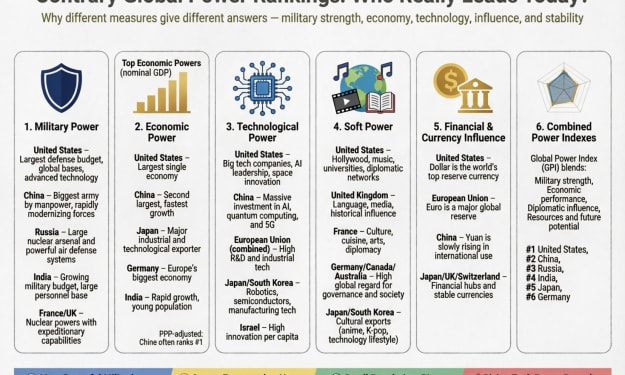
Contrary Global Power Rankings: Who Really Leads Today?
Contrary Global Power Rankings: Who Really Leads Today? When we talk about the “most powerful countries in the world,” many people immediately think of military strength or economic size. But real global power is complex and multidimensional. A country may have the largest economy, while another may have the strongest army, and yet another may wield outsized cultural influence. Different ranking systems lead to different leaders — and sometimes surprising results.
By Wings of Time 14 days ago in Earth
Could AI Trigger World War III?
Could AI Trigger World War III? Artificial Intelligence is changing how wars are planned, predicted, and possibly started. Unlike past technologies, AI does not only build weapons—it makes decisions. This is why many experts now ask a frightening question: could AI trigger World War III? The danger does not come from evil machines, but from how humans are using speed, automation, and data in a world full of mistrust.
By Wings of Time 16 days ago in Earth
When Algorithms Hold the Trigger
When Algorithms Hold the Trigger Nuclear weapons were designed to prevent war, not to be used. For decades, the fear of total destruction forced world powers to act carefully. Human judgment, long chains of command, and political hesitation acted as natural brakes. Today, those brakes are weakening. Artificial Intelligence is slowly entering the most dangerous space on Earth: nuclear command and control.
By Wings of Time 16 days ago in Earth
AI, Surveillance, and Future Control System
AI, Surveillance, and Future Control Systems Artificial Intelligence and advanced surveillance technologies are rapidly changing how power is exercised in the modern world. What once required armies, police forces, and physical borders can now be done through data, algorithms, and invisible systems. Governments and corporations increasingly rely on digital tools to monitor behavior, predict actions, and influence decisions. This shift is creating a new kind of control—quiet, efficient, and deeply powerful.
By Wings of Time 16 days ago in Earth
Why India's Water Is Vanishing
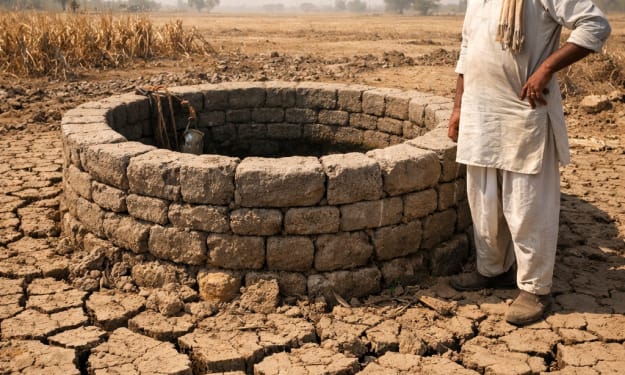
Imagine standing in a vast field that once bloomed with lush green crops, now reduced to a mosaic of deep cracks under a relentless sun. A farmer tilts his head back, sipping the last drops from a clay pot, his face etched with worry. This isn't a scene from a distant dystopia it's the reality for millions in rural India today. Groundwater, the invisible lifeline that sustains over 60% of India's irrigated agriculture and provides drinking water to countless households, is disappearing at an alarming rate. India is the world's largest user of groundwater, extracting more than the United States and China combined. Yet, this precious resource is being depleted faster than nature can replenish it, creating a silent crisis that threatens food security, livelihoods, and the environment.
By Arjun. S. Gaikwad17 days ago in Earth