lifestyle
Living your life - the health and wellness way.
Preservation as an Act of Care
Care is usually associated with people, not with ideas. It brings to mind attentiveness, patience, protection, and responsibility toward something fragile. Meaning rarely enters that picture. Thoughts are assumed to be abundant, replaceable, and endlessly renewable. If one is lost, another will come. This assumption feels practical, but it is wrong in a quiet and costly way. Some meanings are not interchangeable. Some insights arrive only once, shaped by a particular moment, a particular season, or a particular convergence of experience that will never repeat in the same form.
By Peter Thwing - Host of the FST Podcast13 days ago in Longevity
Legendary Golden Fabric Lost for 2,000 Years Comes Back to Life. AI-Generated.
Few discoveries capture the imagination like the return of a lost treasure—especially one that is as tactile and visual as a legendary textile. Recently, a team of scientists in South Korea achieved the impossible: they brought back a golden fabric lost for over 2,000 years, a luxurious material once reserved for emperors and high-ranking elites in ancient civilizations. This remarkable achievement not only revives a historical marvel but also opens doors to sustainable fashion and advanced material science.
By Ayesha Lashari16 days ago in Longevity
Novo Nordisk Sues Hims & Hers Over Cheaper Copycat Wegovy Pills and Injections. AI-Generated.
In a significant legal development in the pharmaceutical industry, Novo Nordisk, the maker of the popular weight loss drug Wegovy, has filed a lawsuit against Hims & Hers Health Inc., accusing the company of producing and selling cheaper, copycat versions of Wegovy’s pills and injections. The lawsuit, which has raised concerns about intellectual property rights, competition, and the future of weight loss treatments, has sent shockwaves through the healthcare market.
By Ayesha Lashari16 days ago in Longevity
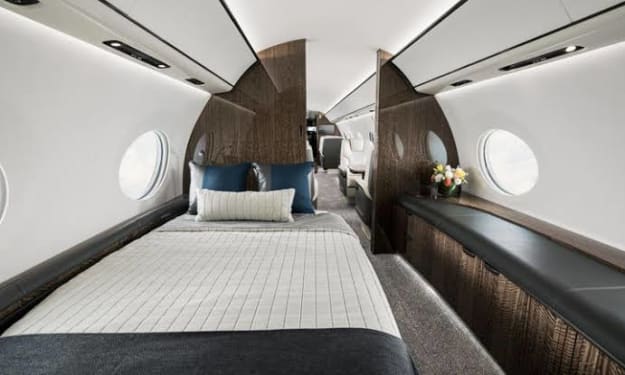
Luxury Travel Takes Off as Plane Makers Chase Asia’s Super-Rich. AI-Generated.
Luxury air travel is soaring across Asia as aircraft manufacturers and private jet companies compete to capture the attention of the region’s rapidly growing population of ultra-wealthy travelers. With business fortunes rising and leisure travel rebounding strongly after the pandemic, Asia has become the world’s most promising market for private aviation and high-end commercial aircraft cabins. Industry executives say demand for private jets, customized aircraft interiors, and premium long-haul travel experiences has surged in countries such as China, India, Singapore, Indonesia, and Thailand. Wealthy individuals increasingly want faster, more flexible ways to travel, avoiding crowded airports and commercial flight schedules. “Asia is now the center of growth for luxury aviation,” said one senior executive at a European aircraft manufacturer. “We are seeing first-time buyers alongside experienced customers upgrading to larger, longer-range aircraft.” A Growing Market of High-Net-Worth Travelers According to aviation industry data, Asia-Pacific now accounts for one of the fastest-growing private jet fleets in the world. The number of high-net-worth individuals in the region has expanded sharply over the past decade, driven by technology, finance, real estate, and manufacturing fortunes. Private jet ownership, once rare in Asia, is becoming more common among billionaires and multinational executives who value privacy, time efficiency, and control over their travel environment. Charter services have also grown rapidly, allowing wealthy travelers to rent luxury aircraft without purchasing them outright. Luxury airlines have taken note as well. Several carriers have invested heavily in first-class suites and business-class cabins designed to resemble hotel rooms in the sky. Features such as private bedrooms, showers, gourmet dining, and personal butler-style service are becoming major selling points. Plane Makers Redesign for Comfort and Status Aircraft manufacturers including Airbus, Boeing, and leading business jet producers are tailoring designs specifically for Asian customers. These include wide-body jets converted into flying palaces with meeting rooms, entertainment lounges, and master bedrooms. Customization has become a key part of the sales pitch. Buyers can choose everything from marble bathrooms to gold-accented interiors, as well as advanced communication systems for in-flight business operations. “Customers don’t just want transportation,” said a luxury aircraft interior designer based in Singapore. “They want a symbol of success and a private space that reflects their lifestyle.” In response, plane makers have opened design centers in Asia to work directly with clients. These studios allow customers to preview cabin layouts and select materials and technologies before committing to purchases that can exceed $100 million per aircraft. Business Travel Meets Leisure A major driver of the trend is the blending of business and leisure travel, often called “bleisure.” Executives want aircraft that can serve as both office and retreat, allowing them to hold meetings in the air and then relax with family on the same trip. Destinations such as the Maldives, Bali, Japan, and Europe’s luxury resorts have seen an influx of travelers arriving on private or semi-private flights. The flexibility allows travelers to avoid busy hubs and fly directly to smaller airports closer to their final destinations. Luxury travel agencies report a sharp rise in bookings for bespoke itineraries that combine private flights, exclusive hotels, and curated experiences such as private island stays or access to cultural landmarks after hours. Environmental and Social Questions The boom in luxury aviation also raises environmental concerns. Private jets produce significantly higher carbon emissions per passenger than commercial flights. As climate awareness grows, critics argue that expanding private aviation sends the wrong message in a region already struggling with pollution and rising temperatures. Some aircraft makers are promoting newer, more fuel-efficient engines and the use of sustainable aviation fuel (SAF). Several luxury operators have begun offering carbon offset programs, though environmental groups say these measures do not fully address the issue. “There is a clear contradiction between climate goals and the expansion of private aviation,” said an environmental policy expert. “The industry must demonstrate real commitment to sustainability.” Competition Intensifies With Asia now seen as the next frontier, competition among manufacturers and charter operators is intensifying. Companies are hosting exclusive showcase events in cities such as Shanghai, Hong Kong, and Dubai to attract elite customers. These events feature luxury interiors, virtual tours, and private demonstrations of aircraft capabilities. Financial institutions have also entered the market, offering specialized leasing and financing packages for high-end aircraft buyers. This has lowered barriers to entry for wealthy entrepreneurs who prefer not to pay the full cost upfront. Meanwhile, regional governments are expanding private aviation infrastructure by upgrading airports and building dedicated terminals for business jets. Singapore, for example, has invested heavily in private aviation facilities to strengthen its role as a regional hub. A Symbol of Post-Pandemic Wealth Analysts say the rise of luxury aviation reflects broader economic shifts in Asia. While many ordinary travelers remain sensitive to airfare prices, the ultra-rich are spending more freely than ever on premium experiences. “Luxury travel has become a statement of recovery and power,” said a travel economist. “It shows who benefited most from the post-pandemic economy.” Looking Ahead Industry forecasts suggest Asia’s luxury aviation market will continue growing over the next decade, driven by rising wealth, expanding tourism, and a desire for exclusive travel experiences. For plane makers, the challenge will be balancing luxury with sustainability while adapting to cultural preferences across diverse Asian markets. As the world’s super-rich take to the skies in ever more elaborate aircraft, luxury travel is no longer just about reaching a destination. In Asia, the journey itself has become the ultimate display of status, comfort, and global ambition.
By Fiaz Ahmed 17 days ago in Longevity
Common Intimacy Mistakes Couples Make
Intimacy is one of the most important parts of a strong and lasting relationship. But for many couples, intimacy slowly fades over time—not because love disappears, but because small mistakes build up without anyone noticing.
By Artical Media17 days ago in Longevity
Roots and Fruit
Most people evaluate life by what shows. Results, behavior, success, failure, growth, collapse. Fruit is easier to measure than roots, so it becomes the focus almost by default. When something goes wrong, attention rushes to what is visible and immediate. When something goes right, credit is assigned to the most recent action. But this way of seeing consistently misreads causality. Fruit is never the beginning of the story. It is the result of something that has been growing quietly, often unnoticed, for a long time.
By Peter Thwing - Host of the FST Podcast17 days ago in Longevity