politics
Politics does not dictate our collective cultural mindset as much as it simply reflects it; We've got to look in the mirror sometimes, and we've got one.
Russia ‘Has Not Won’ as Ukraine War Enters Fifth Year, Zelenskyy Says. AI-Generated.
Ukrainian President Volodymyr Zelenskyy has declared that **Russia “has not won” as the war in Ukraine enters its fifth year, emphasizing Kyiv’s determination to continue fighting despite immense human cost and a grinding stalemate on the battlefield. In a nationally broadcast address on Tuesday, Zelenskyy reiterated that Russia’s invasion has failed to break Ukrainian resolve or achieve its strategic objectives, even as thousands more lives have been lost and substantial swathes of Ukrainian territory remain contaminated by ongoing combat and occupation. “The enemy has not won and will never gain a victory on our land,” Zelenskyy said, reflecting a theme of resilience that has characterized Ukrainian leadership since Russia’s February 24, 2022 invasion. “This is not only a military struggle but a battle for our statehood, our identity, and the future of Europe.” Fifth Year of War The conflict entered its fifth year amid what military analysts describe as a protracted war of attrition. Front lines in the eastern and southern regions have largely stabilized, though occasional localized offensives and artillery duels continue. Ukrainian forces have sought limited counterattacks to disrupt supply lines and regain territory, but strategic breakthroughs have been rare. Russia, for its part, continues to reinforce positions and conduct missile and drone strikes across Ukraine, frequently targeting energy infrastructure and civilian areas, particularly during winter months. Moscow’s official narrative frames the campaign as a defense against Western influence and a struggle to protect Russian-speaking populations in Ukraine’s east. Zelenskyy’s address acknowledged the toll of nearly five years of conflict: disrupted communities, destroyed infrastructure, and a generation of children who have grown up amid air-raid sirens. Even so, he emphasized that Ukraine’s international alliances and domestic resistance have countered Russia’s broader ambitions. International Support and Political Divisions Ukraine’s survival has depended heavily on ongoing support from Western partners, particularly the United States and European Union members, which have supplied weapons, funds, and diplomatic backing. However, this support has periodically encountered political headwinds, particularly as debates over budget priorities and election cycles influence policy in capitals such as Washington and Berlin. “We are grateful for the support of our partners,” Zelenskyy said, thanking nations that have provided artillery systems, anti-aircraft missiles, and training for Ukrainian troops. “But we also understand that this war will not end until we regain every inch of our sovereign territory.” Political divisions abroad have occasionally slowed Western aid and complicated unified responses. Hungarian and Slovak leaders, for example, have at times expressed reservations about certain aid packages, arguing for greater oversight or alternative diplomatic approaches. Despite these challenges, Zelenskyy stressed that Ukraine remains committed to pursuing every possible avenue of international coordination — from military alliances to economic diplomacy — while maintaining its own agency on the battlefield. Human Cost and Civilian Hardship As the war enters its fifth year, the human cost continues to mount. United Nations agencies and humanitarian organizations report tens of thousands of civilian casualties, while millions have been displaced either internally or as refugees abroad. Rebuilding homes, schools, and hospitals in frontline regions remains a daunting task under conditions of active danger. “We remember every name, and we fight for every future,” Zelenskyy said, addressing the families of fallen soldiers and victims of attacks. His message was one of shared grief and collective purpose, a reminder that the war’s impact extends far beyond strategic lines on a map. Future Prospects Military analysts believe that the coming year will be critical in determining whether the conflict remains frozen, escalates further, or transitions into a new phase. Ukraine’s ability to secure advanced air-defense weapons, sustained ammunition supplies, and cohesive diplomatic backing may influence both the length and outcome of the war. Russia’s long-term goals remain opaque, with some analysts arguing that Moscow is seeking to consolidate territorial control rather than achieve complete military victory. Others suggest that internal pressures within Russia, including economic sanctions and political dissent, could shape Moscow’s willingness to negotiate. Yet for Ukrainians in both government and society, the message remains resolute: Russia has not won, and the struggle for sovereignty, security, and dignity continues unabated.
By Fiaz Ahmed about 24 hours ago in The Swamp
Trump’s New Tariff Comes into Effect at Lower Than Expected Rate. AI-Generated.
A new tariff introduced by Donald Trump has officially come into force in the United States, but at a significantly lower rate than many economists and industry groups had anticipated. The decision has eased immediate fears of sharp price increases while still signaling a renewed commitment by the administration to its protectionist trade agenda. The tariff, which targets a broad range of imported industrial and consumer goods, was initially expected to be set at a rate of up to 15 percent. Instead, the finalized measure applies a baseline rate of 7 percent, according to officials from the U.S. Department of Commerce. The administration described the lower figure as a “calibrated step” aimed at protecting domestic industries without triggering sudden inflation or retaliation from key trading partners. A Shift from Hardline Expectations When the proposal was first announced earlier this year, business leaders and financial markets reacted with concern, warning that higher tariffs could disrupt supply chains and push up costs for American consumers. Many companies had begun preparing contingency plans, including sourcing materials from alternative countries or passing additional costs on to customers. However, the administration’s revised approach appears designed to balance political messaging with economic caution. A senior White House official said the lower-than-expected rate reflected “careful consultation with manufacturers, farmers, and retail groups.” “This is not about shocking the economy,” the official said. “It’s about giving American producers a fair chance to compete while keeping prices stable for families.” Economic Impact and Market Reaction Markets responded positively to the announcement. Major stock indexes rose modestly after the tariff rate was confirmed, reflecting investor relief that the policy would be less disruptive than initially feared. Analysts said the reduced tariff could limit short-term inflationary pressure while still encouraging companies to invest in domestic production. Economists estimate the new tariff will generate several billion dollars annually in revenue, though far less than earlier projections. Importers will be required to pay the levy at ports of entry, and the cost may eventually be shared between foreign exporters, U.S. companies, and consumers. Retail groups welcomed the adjustment. One national trade association said the decision showed “a recognition that aggressive tariffs can hurt the very people they are meant to protect.” Political and Strategic Messaging The tariff remains a key part of Trump’s broader strategy of reshaping global trade relationships. Throughout his political career, he has argued that the United States has been treated unfairly by international trade rules and foreign competitors, particularly in manufacturing and steel production. By implementing the tariff at a lower rate, the administration can claim progress toward protecting domestic jobs while avoiding the political fallout of sharp price increases. Supporters view the move as a pragmatic compromise that keeps pressure on foreign exporters without escalating into a full trade conflict. Opposition lawmakers, however, criticized the policy as unnecessary and symbolic. One senior Democrat said the tariff would “create uncertainty for businesses and risk alienating allies at a time when economic cooperation is needed.” International Response Several U.S. trading partners are closely monitoring the situation. Officials in Europe and Asia have so far avoided public retaliation, noting that the lower tariff rate reduces the risk of a trade war. Still, diplomatic sources say governments are preparing contingency plans in case further increases are announced. The World Trade Organization has also taken note of the measure. While the tariff falls within existing U.S. legal frameworks, experts warn that prolonged use of unilateral trade actions could invite formal disputes under international trade rules. Business Adjustments Underway For American businesses, the new tariff creates both challenges and opportunities. Domestic producers in sectors such as steel, machinery, and electronics may benefit from reduced competition from cheaper imports. Import-dependent companies, meanwhile, are exploring ways to absorb or offset the added costs. Some firms have already begun renegotiating contracts with overseas suppliers, while others are considering shifting parts of their supply chains closer to home. Analysts say the lower rate gives companies more time to adapt gradually rather than forcing abrupt changes. Looking Ahead While the tariff is now in effect, officials emphasized that it could be adjusted in the coming months depending on economic conditions and trade negotiations. The administration has left open the possibility of raising the rate if foreign governments fail to make concessions in ongoing talks. For now, the lower-than-expected tariff has tempered immediate economic fears while reinforcing Trump’s message that trade policy will remain a central tool of his economic strategy. Whether this approach delivers long-term benefits or merely postpones larger trade disputes remains an open question.
By Fiaz Ahmed about 24 hours ago in The Swamp
Prominent Russian Scholar of North Korea Says He Was Expelled from Latvia Following Detention. AI-Generated.
A prominent Russian academic specializing in North Korea has said he was expelled from Latvia after being detained by authorities, in an incident highlighting the growing tensions surrounding Russian citizens in Europe amid geopolitical disputes. The scholar, known for decades of research on Pyongyang’s political and military strategies, claims that Latvian security services questioned him for several hours before ordering him to leave the country immediately. In statements to Russian media outlets, the academic said he was traveling to Riga for a series of research meetings and consultations with European colleagues. He described his detention as abrupt, with officials citing “national security concerns” but providing no detailed explanation. “I was treated not as a scholar, but as a threat,” he said. “There was no formal accusation, no evidence presented, just the directive to depart.” Latvian authorities have not publicly disclosed the identity of the scholar or the specific reasons for his removal. A spokesperson for the Ministry of Interior confirmed that a Russian national had been expelled under administrative procedures, noting that the move was taken to safeguard national security, but declined to provide further details. Academic Profile and Work The expelled scholar is recognized for his extensive work on North Korea’s political system, leadership dynamics, and relations with major powers such as Russia and China. His publications include numerous books and peer-reviewed articles examining Pyongyang’s foreign policy, military doctrine, and ideological evolution. He has also served as a commentator on Russian media, offering insights into North Korea’s nuclear program and regional diplomacy. Colleagues emphasized that the scholar’s research is strictly academic and not affiliated with intelligence activities. “He has spent his career analyzing North Korea’s internal politics and international behavior,” said one researcher at a Moscow think tank. “There is no evidence linking him to any operational work for the Russian state.” Security Concerns and Regional Context The Baltic states, including Latvia, have tightened security measures for Russian nationals following Russia’s full-scale invasion of Ukraine in 2022. Heightened scrutiny is applied to individuals with backgrounds in defense, international relations, or strategic studies. Authorities argue that vigilance is necessary to prevent espionage or influence operations, even when dealing with academic visitors. Experts note that the North Korea specialization adds sensitivity. Analysts suggest that European security services view Russian scholars focused on Pyongyang through a lens of geopolitical risk, particularly given Moscow’s evolving military and technological ties to Pyongyang. Reaction and Academic Freedom Debate The scholar’s expulsion has sparked concern in academic and human rights circles. Advocates warn that treating researchers as potential security threats could chill intellectual exchange and isolate scholars from international collaboration. “This sets a worrying precedent,” said a European university professor who works on East Asian politics. “When academics are treated as suspects solely because of their nationality or area of expertise, it undermines the principles of open inquiry.” Russian officials condemned Latvia’s action, describing it as discriminatory. A spokesperson for the Russian foreign ministry stated that the expulsion reflects “the unfair treatment of Russian citizens abroad” and called for the country to respect the scholar’s professional work. Implications for Academic Mobility The incident highlights the fragility of academic mobility between Russia and Europe. Visa restrictions, canceled conferences, and heightened security checks have already made travel challenging for Russian scholars. Experts say that the removal of a specialist in North Korean studies may further hinder international collaboration in fields critical to global security understanding. The scholar has indicated that he may pursue legal avenues or appeal through international organizations, though such challenges are rarely successful in overturning administrative expulsions. For now, he remains in Russia, reflecting on the broader impact of politics on academic work. A Precarious Environment for Research As geopolitical tensions continue to affect scholarly exchange, the case underscores the thin line between security concerns and the suppression of academic freedom.
By Fiaz Ahmed about 24 hours ago in The Swamp
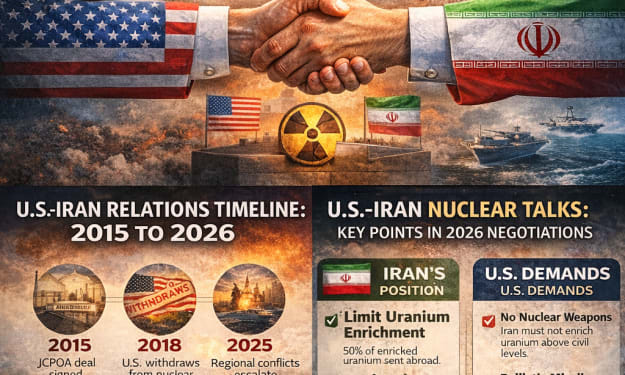
U.S.–Iran Relations in 2026: Nuclear Negotiations, Tensions, and a World on Edge
The Context: A Long History of Tension Relations between the United States and Iran have been fraught since the 1979 Islamic Revolution, when the U.S.-backed shah was overthrown and American diplomats were held hostage for 444 days. Decades of mistrust followed, marked by sanctions, proxy conflicts, and sharply diverging regional priorities.
By shahkar jalala day ago in The Swamp
Twenty U.S. Men’s Olympic Hockey Players to Attend Trump’s State of the Union Address. AI-Generated.
Twenty members of the U.S. men’s Olympic hockey team have been invited to Washington to attend former President **Donald Trump’s State of the Union address as special guests, a move that blends sport, patriotism, and politics at a moment when hockey’s profile in the United States is arguably at its highest. The invitation follows the historic performance of the U.S. team at the 2026 Winter Olympics in Italy, where the Americans captured the gold medal in dramatic overtime fashion over traditional rival Canada men's national ice hockey team. The victory marked the first Olympic men’s hockey gold for the United States since the 1980 “Miracle on Ice,” and the achievement has resonated deeply with fans across the country. While Trump is no longer in the White House, he remains a significant figure in the political landscape, particularly among conservative voters and Republican Party activists. The invitation to the State of the Union address — which Trump has described as a chance to highlight national accomplishments and set priorities for the coming year — was extended by Republican leaders in Congress and accepted by the hockey players and their families. A Blend of Sport and National Pride Olympic team captains, coaches, and representatives confirmed that the players view the invitation as an opportunity to celebrate their achievement and represent their sport on a national stage. “It’s an incredible honor to be recognized in the Capitol,” said a veteran forward on the team. “We competed for our country in Italy, and it’s humbling to be invited to such a historic event.” Team members have said they intend to focus on the unity and pride that sports can generate, rather than political discussion. Several players emphasized that their appearance is about honoring their teammates, families, and the fans who supported them through a grueling Olympic schedule. However, the optics of the invitation are not without controversy. Critics argue that by attending a high-profile political event hosted by a former president with a deeply partisan following, athletes risk being drawn into political symbolism that could overshadow their sporting achievements. Athletes, Politics, and Public Life The intersection of politics and elite sport is not new in the United States. From Olympic visits to presidential receptions to national anthems and kneeling protests, American athletes often find themselves at the crossroads of national identity and political debate. Yet the decision of these hockey players to attend a State of the Union address carries particular resonance because of the unique timing — coming just months after their Olympic triumph and during a period of heightened political polarization. Supporters of the team’s appearance argue that elite athletes, like all citizens, have the right to engage with national events and that their presence could serve as a unifying symbol, transcending party lines. “These are young men who brought joy to millions of Americans through sport,” said one Republican congressman involved in extending the invitation. “This is about honoring excellence and national pride, not politics.” Democratic lawmakers, on the other hand, have questioned the decision, suggesting that the presence of national champions at a partisan event may create unnecessary controversy. “Sport should unite, not be used as a platform for division,” one Democratic senator said. Players’ Perspectives Several players have spoken privately about attending the address with a sense of gratitude but also caution. “We represent 330 million Americans,” one alternate captain said. “We want to celebrate our accomplishment and be respectful of everyone, regardless of political views.” Others noted that the experience of representing their country in Italy — and seeing the outpouring of support from fans on both sides of the political spectrum — underscored the unifying power of sports. “When we were playing in Milan and Cortina, it didn’t matter who you supported politically,” another teammate said. “People came together to cheer for Team USA. That’s the message we want to carry with us.” What to Expect in Washington Organizers expect the athletes to receive a standing ovation when they are recognized on the House floor, a tradition extended to Olympians and other national champions. The players are scheduled to be seated together with family members, and they have been instructed to arrive ahead of the televised address to meet with lawmakers and dignitaries. Beyond the recognition during the speech, players may participate in events on Capitol Hill celebrating U.S. athletic achievement, including meetings with members of the Congressional Sportsmen’s Caucus and other groups that champion youth and amateur athletics. A Moment of Recognition Whether seen as a celebration of sport, an intersection with politics, or something in between, the attendance of U.S. Olympic hockey players at the State of the Union address reflects the unique role that elite athletes play in national life. For the players themselves, it remains a rare opportunity to be honored at the heart of American political culture — and a reminder that sporting achievement often resonates far beyond the arena.
By Fiaz Ahmed a day ago in The Swamp